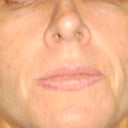
Midface lifts can be done under local anesthesia with sedation (so you're awake but very relaxed) or under general anesthesia, which means you’re fully asleep during the procedure. A growing number of surgeons, including Dr. Mesa, perform the procedure with the patient fully but painlessly awake, under local anesthesia (without IV sedation).
Here’s how the procedure works:
- Once the anesthesia has taken effect, your surgeon will make small incisions near the hairline and around the ear.
- They’ll lift the fat pads in your cheek tissue and anchor them into an elevated position, generally with dissolvable sutures or dissolvable anchoring devices (like Endotine).
- For the longest-lasting results, they may also lift and tighten the underlying muscle and fascia.
- They will then redrape your skin to suit your cheek’s new contours while reducing the appearance of lines and folds.
- Finally, your surgeon will trim away any excess skin before closing your incisions with tiny sutures.
Some surgeons perform endoscopic cheek lift surgery, inserting an endoscope (a tube fitted with a tiny camera, which allows them to view the surgical area) through small incisions in the hairline.
Endoscopic cheek lifts are frequently performed in conjunction with a brow lift or eyelid surgery. Benefits of this technique include smaller scars and a faster recovery, but results don’t always hold up as well as those from a traditional cheek lift, in part because endoscopic procedures don’t remove excess skin. Some doctors on RealSelf also say that the endoscopic technique has a higher risk of asymmetry.
Less commonly, a midface lift is performed through an incision under the lower eyelid. However, this approach has a high risk of ectropion, a pulling or rounding of the lower eyelid.