Kevin M. Robertson, MD, FACS
Verified
Board Certified Facial Plastic Surgeon
Board Certified Facial Plastic Surgeon
My practice is set apart from others based on four main foundations: facial plastic surgery specialization, cosmetic only patient care, experience in both academic and private facial plastic surgery environments, and absolute dedication to my patient results

Asked By: prbarbour
ANSWER
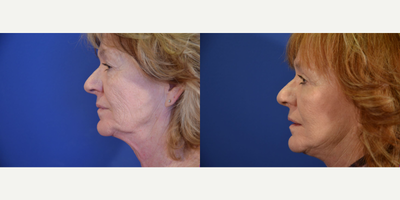
Unfortunately our industry is not uniform in the terminology of our procedures. When you say platysmaplasty, does that mean that you only had an anterior approach with an incision under your chin, or the anterior platysmal work was combined with incisions around the ear (and SMAS reposition) that I would characterize as a more conventional facelift? Because what you see in your current picture is a lack of fat in the midline, persistent anterior platysmal bands, skin redundancy, and overall jawline laxity. Right now there is only one option, and that is revision surgery. Do not consider nonsurgical options for a surgical problem. Revision should include repeat anterior exposure, band reapproximation in midline (and possible backcut below), skin elevation, and posterior platysmal lift to restore your neck and jawline contours. Freely discuss these concerns with your surgeon
Asked By: Lili786
ANSWER
The long term survival of the fat depends on the adherence to gentle harvest, minimal manipulation during purification, and placement that maximizes blood supply in the recipient site. Anything that helps these three things will help fat survive in excess of 60% of the initial transfer. That is why the surgeon choice is important. Based on data, fat from the abdomen has the highest survival rate (lots of stem cells in there), harvested with low vacuum syringes with cell friendly cannulas. Purification with limited centrifugation or specific harvest systems commercially available. Replacement with small cannulas in microtunnels with lots of blood supply. So to answer your question, it has been published about repositioning fat in muscle (called FAMI). Good blood supply, but quite frankly the facial muscle target is thin and would hurt from all that swiss cheese treatment. So placement in multiple planes of the subcutaneous tissue is performed. Deeper placement hides better, and can push against the facial skeleton to lift more efficiently. In my opinion, thats the most important factors
Asked By: syndicate
ANSWER
The answer is simply no, a caudal septal extension graft does not need to be stabilized with extended spreader grafts. They can simply be secured to the lower (caudal) part of the pre-existing septum using stable stitches. That effectively elongates the septum, pushes the lower lateral cartilage down to derotate the tip.An extended spreader graft is a second way to lengthen or turn the nose down. My fellowship director, Dr Wally Dyer, published this as the DART, or Dyer Advancement Rotation Technique, many years ago. In his description, the extended spreaders were secured to a columellar strut, which then served as an anchor to turn the tip down. There have been a number of experienced rhinoplasty specialists who have described similar techniques. Either way surgeons have their preferred way to move the tip downward while still controlling projection. A caudal septal extension graft is one way, extended spreader grafts represent another option, and other tip grafting techniques add yet other steps. Trust your surgeon to work with the technique(s) that he/she feels most comfortable in order to serve your needs.
Asked By: mrose1979
ANSWER
Your question is very common, so we have a number of options. But first a couple of simple answers. Microneedling has value, but its for skin quality. It will help to give you radiance, and a healthier look, but will not affect how tight the skin drapes. As for your jawline you could do a very simple liposuction, which is a clinic procedure with little or no downtime. The excess fat (regardless of your weight) can be artistically scupted away from both neck and jowl, leaving you with a more refined jawline and profile. You can also do this to a lesser degree using a multistep injection of kybella, but my preference is still a single event lipo.The true secret is to recognize what you also pointed out about flatter cheeks. If you can restore volume high in the cheeks, it will also rebalance the face and actually create the illusion of a more refined jawline. The face shape takes on a more youthful character of an inverted triangle or heart-shape. That can be done at the same time with either injectable fillers, or even a straightforward fat transfer. You would be plenty happy with the lipo alone, but this would be the completion of the project!
Asked By: momo_1234
ANSWER
First let me tell you that you can relax about your sleeping pattern. There has never been any evidence that supports the requirement to sleep on your back, just a series of suggestions. Like all other rhino docs, I will tell my patients to sleep with at least a 30 degree upright angle for the first couple of nights in order to reduce initial swelling. But many of my patients wake up on one side or the other, so your story is not uncommon. When you wake up, there is usually a little setback because of new swelling, but that tends to resolve and then further refine for the rest of the day. That will be accentuated on one side, the low side, if you happen to roll over during the night. Normal human physiology.The key is first to relax. Your nose will turn out fine, and the best medicine is time. Second, do your best. Sleeping upright helps, but everyone tosses and turns to some degree. So don't beat yourself up for doing what your body wants to do. Third, focus on getting quality sleep. A sleepless night in a rigid, upright position is far worse for you than a restful side sleep. So try to begin your rest in a midline upright position and then drift into a quality, rejuvenative sleep. And finally, try a little nasal hygiene right before you go to sleep. That means one good clean of your surgical incisions, some nasal saline to rinse out debris and provide a more valuable nasal airway. That should help open up your breathing and provide an easier rest.
Asked By: juejueb
ANSWER
You always want to consider chin implants, nonsurgical chin augmentation, submental liposuction, or kybella. How each of these relate to your anatomy is beyond the scope of the question, but can be answered by your surgeon at the time of a consult. At that time they can use your profile picture and image modification software to discuss what each change means to your face. My initial impression based on your picture is to consider the submentum first, meaning lipo or kybella.
Asked By: dbart103
ANSWER
You have a couple of options to consider while you heal, since time is truly your best medicine. The cords might be from muscle activity, which responds to botox. Or they might be a bowstring contraction, which should be treated with an injectable steroid like kenalog. Kenalog can also be used for a focal area of thickening, so those harder areas can also be addressed. If the skin is loose, or you see fullness by the gland, then your best treatment is simple massage and time.The key is to continue to communicate with your surgeon. He or she is committed to your happiness, and will always be your first resource for help.
Asked By: 43567808746734
ANSWER
You can indeed bring up your bridge with soft tissue fillers. To a degree. If you try to build it up too far or too fast, you will lose precision and the nose just looks like a swollen blob. So serial, stepwise, conservative, thoughtful augmentation might get you some of what you are looking for. The problem can also be that the tip does not respond well to filler. Much less likely to get precise highlights or projection, so temper your expectations here. The key is to first find a surgeon to do this. I would not suggest letting anyone who does not operate on a nose consider a filler here. Second you have to have an honest conversation with that surgeon about your expectations, vs what can be achieved. If you are on the same page, proceed with anticipation!
Asked By: amijjfield
ANSWER
There are many options for rhinoplasty that will open up the nasal airway. They include septal straightening, turbinate reduction, internal valve and/or external valve collapse correction. Unfortunately there is no way to answer your questions without an evaluation. You may have other reasons for airway obstruction, like mucosal congestion, that would not change with any surgery. So a global answer that promises airway improvement with rhinoplasty is premature.Patients with significant allergies, non-allergic rhinitis, or even a few congenitally-narrowed nose obstructions would still have to work with medicines and non-surgical treatments.
Asked By: Cyntheeeahh
ANSWER
You have two questions at issue here. One, who should do your injection? Second, what can I expect from the injection overall?The degree or specialty of your provider is not as important as their experience and approach. If you get a really good nurse injector, that's still an option. But we often make attempts to point out that your best results most often lie in the core disciplines, ie derm plastic surgery oculoplastic surgery and facial plastic surgery. They are the experts and offer you the best chance for safe, reproducible results.It's what they were trained to do, its the specialty they practice.I would have to warn you that you must be very careful with your injections. Botox can block the signal of the nerve to your sweat glands, reducing hyperhydrosis. However in 20 years I have never injected the areas you suggest for sweating (and we are in the top 3% of injection volume in the country). The reason is that you may also have the botox affect the muscles under the skin, causing all sorts of awkward and unattractive facial movements if your lip or nose do not move normally. The injections have to be in the skin and not under the skin in the muscle, so your margin of correction is very tight. Find someone very very experienced with botox before jumping into this one, and consider treating only a small portion of your concerned area first to make sure its safe and effective on your body.
Dr. Kevin M. Robertson is highly regarded for his expertise in a variety of cosmetic procedures, including , , , , , , , , and . Patients consistently praise his skill, attention to detail, and compassionate bedside manner. Many highlight his ability to achieve natural-looking results and his thorough communication throughout the process. His commitment to patient satisfaction and his professional demeanor have earned him strong recommendations from his patients.