
Sponsored by Galderma
A Different Kind of First Pour.
On September 23, RealSelf and Galderma brought together a small group of providers, creators, and press in New York for an intimate conversation around a topic that is finally getting the attention it deserves: menopause, and what it means for skin health.
Moderated by RealSelf CEO Minou Clark, the panel brought together Dr. Doris Day, board-certified dermatologist and founder of Doris Day M.D.; Crystal Muilenburg, VP of Aesthetics Marketing at Galderma U.S.; and Genesis Rivas, Senior Beauty Editor at Oprah Daily.
Together, they explored the science behind menopausal skin changes, the research gaps that still exist, and what a more informed approach to aesthetic care can look like.
Four Perspectives. Four Takeaways.
Across medicine, aesthetics, research, and media, one idea emerged clearly: menopause is changing the conversation around what women need, what providers need to know, and what better-informed care can look like.
1. Dr. Doris Day
Move the conversation from decline to balance.
For Dr. Day, menopause shouldn’t be framed as a loss of youth to be corrected. It’s a biological transition that calls for a more individualized approach to beauty, health, and care.

2. Crystal Muilenburg
The care conversation needs to catch up with the patient.
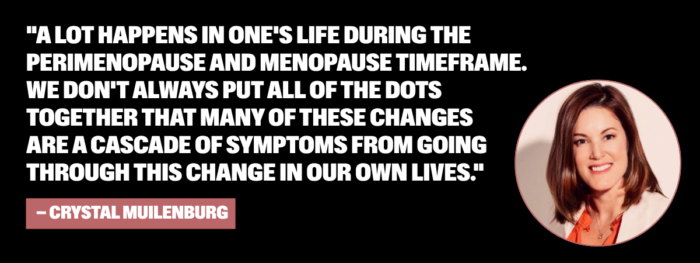
Muilenburg brought the industry lens, pointing to a fundamental gap: women are learning about menopause in real time, while the healthcare and research systems around them are still catching up.
3. Genesis Rivas
Menopause needs to be understood as a health story, not just a beauty story.
As a beauty editor, Rivas sees the cultural shift firsthand. The conversation is moving beyond how women can look younger toward understanding why their skin is changing in the first place.

4. Minou Clark
The opportunity is in connecting the dots.
As moderator, Clark brought the conversation back to what happens when medical expertise, industry research, media, and patient experience start informing one another.

Galderma Is Asking Better Questions.
Galderma’s global research, conducted among more than 4,300 women across nine countries, is helping illuminate how women experience menopause and changes in their skin, and where education and care can improve. The research also reflects a broader shift in how menopause is being studied: Galderma is incorporating menopausal status into clinical-trial data collection across its injectable aesthetics business.
The biology underscores why that matters. Dr. Day pointed to research showing that women can lose up to 30% of their collagen in the first five years after menopause, followed by roughly 2% per year. For providers, those changes have implications for how they think about skin quality, treatment timing, and the mechanisms behind aesthetic outcomes.
Galderma’s portfolio spans biostimulation with Sculptra®, neuromodulation with Dysport® (abobotulinumtoxinA), volume restoration with Restylane®, and skin health with elastin-based skincare and retinol, while its research continues to explore how these tools can be understood in the context of menopausal skin changes.
As Dr. Day put it: “Galderma is the first company that’s asking the questions that are directly targeted to the people that are getting injected in ways that are so specific.”
And perhaps that’s the most interesting place for the industry to be right now: asking better questions, collecting better data, and letting the answers shape what comes next.
Bring the Conversation to Your Community.
For brands looking to create their own meaningful moment around an emerging topic, RealSelf can help bring the right mix of providers, experts, creators, media, and community together in a format built for conversation, education, and connection.
Interested in bringing a collaborative event like this to life?
Email partnerships@realself.com to get the conversation started.
Galderma References
Dysport Important Safety Information
Indication: Dysport® (abobotulinumtoxinA) is a prescription injection for temporary improvement in the look of moderate to severe frown lines between the eyebrows (glabellar lines) in adults less than 65 years of age.
WARNING: DISTANT SPREAD OF TOXIN EFFECTS
What is the most important information you should know about Dysport? In some cases, the effects of Dysport and all botulinum toxin products may affect areas of the body away from the injection site. Symptoms can happen hours to weeks after injection and may include swallowing and breathing problems, loss of strength and muscle weakness all over the body, double vision, blurred vision and drooping eyelids, hoarseness or change or loss of voice, trouble saying words clearly, or loss of bladder control. Swallowing and breathing problems can be life threatening and there have been reports of death. You are at the highest risk if these problems are pre‐existing before injection. These effects could make it unsafe for you to drive a car, operate machinery, or do other dangerous activities.
Do not have Dysport treatment if you: are allergic to Dysport or any of its ingredients (see the end of the Medication Guide for a list of ingredients), are allergic to cow’s milk protein, had an allergic reaction to any other botulinum toxin product, such as Myobloc® (rimabotulinumtoxinB), Botox® (onabotulinumtoxinA), or Xeomin® (incobotulinumtoxinA), have a skin infection at the planned injection site, under 18 years of age, or are pregnant or breastfeeding.
The dose of Dysport is not the same as the dose of any other botulinum toxin product and cannot be compared to the dose of any other product you may have used.
Tell your doctor about any swallowing or breathing difficulties and all your muscle or nerve conditions such as amyotrophic lateral sclerosis [ALS or Lou Gehrig’s disease], myasthenia gravis, or Lambert‐Eaton syndrome, which may increase the risk of serious side effects including difficulty swallowing and difficulty breathing. Serious allergic reactions have occurred with the use of Dysport. Dry eye has also been reported.
Tell your doctor about all of your medical conditions, including if you have surgical changes to your face, very weak muscles in the treatment area, any abnormal facial change, injection site inflammation, droopy eyelids or sagging eyelid folds, deep facial scars, thick oily skin, wrinkles that can’t be smoothed by spreading them apart, or if you are pregnant or breastfeeding or planning to become pregnant or breastfeed.
Tell your doctor about all the medicines you take, including prescription and nonprescription medicines, vitamins and herbal and other natural products. Using Dysport with certain other medicines may cause serious side effects. Do not start any new medicines while taking Dysport without talking to your doctor first.
Especially tell your doctor if you: have received any other botulinum toxin product, such as Myobloc® (rimabotulinumtoxinB), Botox® (onabotulinumtoxinA), or Xeomin® (incobotulinumtoxinA), in the last four months or any in the past (be sure your doctor knows exactly which product you received), have recently received an antibiotic by injection, take muscle relaxants, take an allergy or cold medicine, or take a sleep medicine.
Common Side Effects
The most common side effects include nose and throat irritation, injection site pain, upper respiratory infection, blood in urine, headache, injection site reaction, eyelid swelling, eyelid drooping, sinus infection, and nausea.
Ask your doctor if Dysport is right for you.
You are encouraged to report negative side effects of prescription drugs to the FDA.
Visit www.fda.gov/medwatch or call 1‐800‐FDA‐1088.
Please see Dysport Full Prescribing Information including Medication Guide at DysportUSA.com.
Restylane Family Important Safety Information
The Restylane® family of products are indicated for patients over the age of 21, and includes Restylane®, Restylane®-L, Restylane® Lyft with Lidocaine, Restylane® Silk, Restylane® Kysse, Restylane® Refyne, Restylane® Defyne, Restylane® Contour, and Restylane® Eyelight.
Restylane and Restylane–L are for mid-to-deep injection into the facial tissue for the correction of moderate-to-severe facial wrinkles and folds, such as nasolabial folds, and for lip enhancement.
Restylane Lyft with Lidocaine is for deep implantation into the facial tissue for the correction of moderate-to-severe facial wrinkles and folds, such as nasolabial folds, and for cheek augmentation and for the correction of age-related midface contour deficiencies. Restylane Lyft with Lidocaine is also indicated for injection into the dorsal hand to correct volume loss. Restylane Lyft with Lidocaine is also indicated for injection into the mid-to-deep dermis (subcutaneous and/or supraperiosteal) for augmentation of the chin region to improve the chin profile in patients with mild-to-moderate chin retrusion.
Restylane Silk is for lip augmentation and for correction of perioral wrinkles.
Restylane Kysse is for lip augmentation and for correction of upper perioral wrinkles.
Restylane Refyne is for mid-to-deep injection into the facial tissue for the correction of moderate-to-severe facial wrinkles and folds, such as nasolabial folds.
Restylane Defyne is for mid-to-deep injection into the facial tissue for the correction of moderate-to-severe, deep facial wrinkles and folds, such as nasolabial folds. Restylane Defyne is also indicated for injection into the mid-to- deep dermis (subcutaneous and/or supraperiosteal) for augmentation of the chin region to improve the chin profile in patients with mild-to-moderate chin retrusion.
Restylane Contour is for cheek augmentation and for the correction of midface contour deficiencies, and for correction of temple hollowing.
Restylane Eyelight is for the improvement of infraorbital hollowing.
Do not use if you have severe allergies that have required in-hospital treatment, are allergic to lidocaine or gram- positive bacterial proteins used to make hyaluronic acid, prone to bleeding, or have a bleeding disorder. The safety of use while pregnant or breastfeeding has not been studied. Tell your doctor if you are planning other cosmetic treatments (such as lasers and chemical peels) as there is a possible risk of inflammation at the injection site.
The most common side effects include swelling, redness, pain, bruising, headache, tenderness, lump formation, itching at the injection site, and impaired hand function (Restylane Lyft – hand injection). Tell your doctor if you’re taking medications that lower your body’s immune response or affect bleeding, such as aspirin or warfarin; these medications may increase the risk of bruising or bleeding at the gel injection site. Use at the site of skin sores, pimples, rashes, hives, cysts, or infection should be postponed until healing is complete.
Delayed-onset inflammation near the site of dermal filler injections is one of the known adverse events associated with dermal fillers, and cases have been reported to occur at the dermal filler treatment site following viral or bacterial illnesses or infections, vaccinations, or dental procedures. Typically, the reported inflammation was responsive to treatment or resolved on its own. Serious but rare side effects include delayed-onset infections, recurrence of herpetic eruptions, superficial necrosis, and scarring at the injection site. The risk of unintentional injection into a blood vessel is small but can occur and could result in serious complications, which may be permanent including, vision abnormalities, blindness, stroke, temporary scabs, or permanent scarring of the skin. As with all skin injection procedures, there is a risk of infection.
To learn more about serious but rare side effects and full Important Safety Information, visit www.RestylaneUSA.com.
Sculptra Important Safety Information
Sculptra® (injectable poly-L-lactic acid [PLLA-SCA]) is indicated for correction of shallow to deep nasolabial fold contour deficiencies, fine lines and wrinkles in the cheek region, and other facial wrinkles.
Sculptra should not be used by people that are allergic to any ingredient of the product or have a history of keloid formation or hypertrophic scarring. Safety has not been established in patients who are pregnant, lactating, breastfeeding, or under 18 years of age.
Sculptra has unique injection requirements and should only be used by a trained healthcare practitioner. Contour deficiencies should not be overcorrected because they are expected to gradually improve after treatment.
Sculptra should not be injected into the blood vessels as it may cause vascular occlusion, infarction, or embolic phenomena. Use at the site of skin sores, cysts, pimples, rashes, hives, or infection should be postponed until healing is complete. Sculptra should not be injected into the red area (vermillion) of the lip or in the peri-orbital area.
The most common side effects after initial treatment include injection site swelling, tenderness, redness, pain, bruising, bleeding, itching, and lumps. Other side effects may include small lumps under the skin that are sometimes noticeable when pressing on the treated area. Larger lumps, some with delayed onset with or without inflammation or skin discoloration, have also been reported.
Sculptra is available only through a licensed practitioner. Complete Instructions for Use are available at www.SculptraUSA.com.