The Naderi Center for Plastic Surgery and Dermatology – Reston
1850 Town Center Pkwy, Pavilion II, Suite 551, Reston, Virginia, 20190
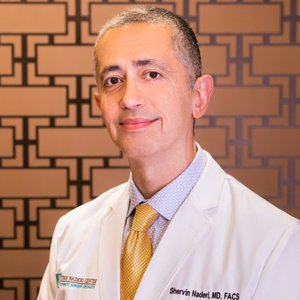
Board Certified Facial Plastic Surgeon
I'm Dr. Shervin Naderi, a double board-certified facial plastic surgeon and founder of The Naderi Center for Plastic Surgery and Dermatology, with offices in Reston, Virginia and Chevy Chase, Maryland. For over 20 years my practice has been devoted exclusiv

Asked By: MGIZ
ANSWER
It depends on what is causing the change. Fillers can restore lost volume and Botox can soften lines from muscle movement, and for patients with mostly volume loss or early aging, this liquid facelift approach can work well. What injectables can't do is reposition descended tissue, remove loose skin or correct significant jowling and neck laxity. Trying to make up for real sagging with more and more filler can make the face look heavier rather than younger, and filler lasts months, not years. I perform my own injections and have a significant injectables practice, so I'm glad to recommend non-surgical treatment when it is the better choice. When descent and laxity are the main problem, surgery gives a more natural and longer-lasting correction. An in-person exam is the best way to decide.
Asked By: myscreenname
ANSWER
They don't have to be staged. Rhinoplasty can be done in the same operation as a deep plane facelift, under one general anesthetic and with one recovery, so the whole face is brought into balance together. Some of my patients choose this because the nose changes with age too, and lifting a drooping tip and balancing the nose can make the whole face look more rested. Keep in mind that each procedure does its own job. Rhinoplasty does not tighten loose skin, and a facelift does not change the shape of the nose. Whether to combine them depends on your anatomy, your health and how much recovery time you have, which is something to plan together with your surgeon at a consultation.
Asked By: mbelmel
ANSWER
For many patients, yes. Facial aging rarely affects just one area, so I evaluate the brows, eyelids, cheeks, jawline and neck together. When more than one area needs help, a deep plane facelift can be combined with eyelid surgery, a brow lift, a neck lift, fat grafting or CO2 laser resurfacing in a single operation, with one anesthetic and one recovery. Doing them together also lets me shape the eyes and cheeks as one smooth transition instead of working around an earlier result. That doesn't mean everyone needs several procedures. I recommend an additional procedure only when it meaningfully adds to the result. If the eyelids are the only concern and the jawline is still firm, eyelid surgery alone may be right, and it can be done years before a facelift is needed. An exam will show which areas are actually aging.
Asked By: Kouz
ANSWER
It can help some patients. Hyperbaric oxygen (HBO) therapy is something some of my patients may benefit from after surgery to support healing, but not everyone needs it, and it does not replace the basics. What makes the biggest difference is being completely nicotine-free, including vaping, gum and patches, well before surgery; resting with your upper body elevated; using cool compresses during the first few days; staying well hydrated; and avoiding heat, sun, flying and strenuous activity early on, since all of these make swelling worse. Swelling, firmness and numbness then keep fading over several months. If you are considering HBO, ask your surgeon whether it fits your situation and when to start it.
Asked By: personable
ANSWER
In my practice, you leave surgery in a pressure wrap that supports the newly repositioned tissues. You come to the office the day after surgery to have it removed, along with any drains, although drains are not usually needed. After that, my patients switch to a Velcro chin strap, which I ask them to wear as much as possible during the early recovery. It should sit comfortably without pleating the skin or pulling it forward, and glasses can rest over the strap rather than on the ears. I follow healing closely and guide patients at every visit. Instructions differ from surgeon to surgeon, so the plan your own surgeon gives you is the one to follow.
Asked By: Anna Ling
ANSWER
At 35, you would be younger than most of the patients I operate on; the 30s are outside the age range where I most commonly perform facelifts. Still, there is no perfect age for a facelift, and anatomy matters more than the number. I'm seeing this more often now with GLP-1 weight-loss medications like Ozempic. Many people in their 30s are losing a lot of weight quickly, and with it the volume that held the face up, which leaves real jowling and loose skin along the jawline and neck. When that happens, the old idea that you're too young for a facelift may not hold true, because that kind of descent and laxity won't get better with filler, lasers or other non-surgical treatments. A facelift is what corrects it. Younger patients also tend to have some of the most natural-looking results: their skin is still elastic, the correction needed is smaller and they heal faster. But there has to be enough of a problem to justify an operation, and if I don't think a facelift will make a meaningful difference, I tell the patient to wait. An in-person exam is the way to know.
Asked By: lizza
ANSWER
Many people assume a deeper operation means a longer recovery, but in experienced hands it usually does not. Swelling and bruising after a deep plane facelift follow much the same course as after a SMAS facelift, and the time before you feel comfortable being seen in public is similar. For my deep plane patients, the pressure wrap comes off the day after surgery and sutures come out at about one week. Most patients feel comfortable going back to work and light social plans at about 3 to 4 weeks and return to exercise after one month. Big events and photos are usually best at about 8 to 16 weeks, and subtle swelling keeps settling for several months. Your own surgeon can tell you how their technique and your anatomy affect your timeline.
Asked By: RealSelf Admin
ANSWER
A deep plane facelift lifts the deeper tissues of the face, not just the skin. Working beneath the SMAS layer, I release the retaining ligaments that hold the cheek and jowl down, so the cheek, jowls and jawline can be repositioned together as one unit. The skin then redrapes with little tension, which is why the result looks natural rather than pulled. Earlier in my career I performed SMAS plication facelifts extensively. Today the extended deep plane approach is my main technique for patients who need comprehensive rejuvenation. It can improve descended cheeks, jowls, jawline definition and the transition into the neck, and it is often combined with a neck lift. I perform it under general anesthesia in the operating room, it takes about 4 hours, and results typically last 10 years or more. Whether it is the right operation for you depends on your anatomy, which an exam will show.
Asked By: Compassionate416739
ANSWER
The right procedure depends on why that eye looks tired, and there are a few common causes. Extra upper eyelid skin, a brow sitting lower on that side, under-eye bags and a hollow under the eye can each create a tired look, and many people have more than one. When only one side looks heavier, the eyelid itself may sit lower on that side, which is called ptosis. Each has a different fix. Extra skin is treated with upper eyelid surgery, a low brow with a brow lift, bags with lower eyelid surgery, and a hollow with fat grafting. Ptosis is a different operation, and I refer those patients to oculoplastic surgeons. Removing skin alone won't fix a low brow or ptosis and can make the eye look droopier. An in-person exam of your brows, lids and cheeks together is the best way to find the cause.
Asked By: spuds62
ANSWER
Eyelid surgery doesn't change the size of the eye itself, but it can make the eyes look more open. When heavy upper lid skin folds over the crease, removing it shows more of the lid, and the eyes look brighter. Lower eyelid surgery through an incision inside the lid removes bags that make the eyes look tired. With age, the eyes also lose volume, and a hollow upper lid can make them look smaller and sunken. I often add a small amount of your own fat along the upper lid and the rim under the brow, which gives a fuller, more youthful look than removing skin alone. If the brow has dropped, resetting it opens the eye area further. If the eyelid itself sits low (ptosis), that is a different operation, and I refer those patients to oculoplastic surgeons. An exam will show which of these applies to you.
Dr. Shervin Naderi continues to receive overwhelmingly positive feedback for his expertise in . Patients express high satisfaction with his skill, professionalism, and the minimal bruising and pain experienced post-surgery. His ability to achieve desired nasal changes and his attentive, communicative approach are frequently highlighted.