
Mark K. Markarian, MD, MSPH, FACS
Board Certified Plastic Surgeon
Board Certified Plastic Surgeon
Show more
Show more
Show more
Dr. Mark Markarian is a Harvard-trained plastic surgeon who’s considered one of the best cosmetic plastic surgeons in the Boston area. His primary office is in Wellesley, Massachusetts, but he also has satellite offices in Newburyport and Woburn, as well as in

Asked By: haruharuu
ANSWER
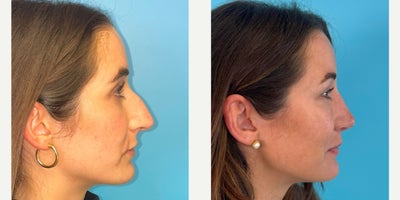
Hello and thank you for your question and photographs. Although an exam in person is ideal, from your photographs alone it appears that you can potentially benefit from a rhinoplasty where some of the following may be pursued: (1) Subtle de-rotation of your nasal tip: I typically utilize extended spreader grafts locked into a columellar strut to de-rotate your nose. This streamlines the nose, supporting the dorsal aesthetic lines, and also facilitates nose and tip support to reduce the risk of crookedness, and tip rotation in the future. I also complement these techniques with a nasal tip deprojection locked into the tip complex for further support. (2) Creation of a tip defining point (or subtle "up-turn"): this can be created with a customized tip graft from fascia, soft cartilage, or both. (3) Augmentation of your dorsum (or bridge): if desired, this can also be performed with diced cartilage wrapped in mastoid fascia. Any (or all) of the above is done with the overall goal of always maintaining a natural appearance. Hope this answer helps. I would recommend your next step to be an in-person consultation with a board certified plastic surgeon to have a more tailored evaluation and response to your specific situation. Good luck and please let me know if I can help. Happy Holidays. Mark K Markarian, MD, MSPH, FACS Harvard-trained Board Certified Aesthetic Plastic Surgeon in Boston & Miami
Asked By: Bryguy12
ANSWER
Hello and thank you for your question. Although your provided MRI sagittal section provides some information, the key question I have for you is this: What is your major symptom? Is it functional, cosmetic, or both? (1) In terms of functional concerns... do you have breathing difficulty? If so, maybe your internal/external nasal valves are collapsed, maybe your septum is re-deviated... in such a case, you may benefit from surgical intervention -- specifically, you may benefit from a revision septoplasty where the deviated septum is revised, excised, and re-set as necessary; any further breathing difficulty can also be improved with spreader grafting for your internal nasal valves or tip grafting for any external nasal valve collapse -- health insurance can cover all this at minimal cost to you☝️ (2) In terms of Cosmetic concerns... you mentioned a concern for "stability" in your question -- do you currently have any visible signs of nose instability? Do you have a collapse of the bridge of your nose? Do you have an open-roof defect? Do you have an inverted-V deformity? If you have any cosmetic concerns, a rhinoplasty can be performed to remedy the above mentioned problems, or any others. Hope this answer helps. I recognize this is a general response and would recommend that you seek an in-person consultation with a board certified plastic surgeon to have a more tailored evaluation and response to your specific situation. Good luck and please let me know if I can help. Happy Holidays. Mark K Markarian, MD, MSPH, FACS Harvard-trained Board Certified Aesthetic Plastic Surgeon in Boston & Miami
Asked By: melesatl
ANSWER
Hello and thank you for your question. Although an exam in person is ideal, from your photograph alone it appears that you can benefit from a rhinoplasty, potentially involving changes to the midvault (or middle third of your nose) and a tip rhinoplasty where the nasal tip cartilage is modified for a more refined, feminine look. Without a profile view, I'm unable to assess the dorsum (or bridge of your nose) to provide any further recommendations for your nose. Of note, if you have any breathing difficulty, a septoplasty or other maneuvers may benefit you as well, and insurance can cover this to reduce the price of your surgery overall☝️ As far as the remainder of your face, some subtle volume enhancements may benefit you, especially since you commented about the thinness of your face. Facial fillers are typical minimally invasive modalities to improve volume (and facial harmony/balance) -- in general, I recommend most patients start this in their 30s or 40s. Although you're smiling in your photo, which alters the appearance of your cheeks, your photo seems to indicate you may benefit from augmentation of your cheeks (with filler) as a "starter" for facial "balancing". Again, these are all just recommendations based solely on the single photograph you provided. Hope this answer helps some, but I would highly recommend that you seek an in-person consultation with a board certified plastic surgeon to have a more tailored evaluation and recommendation of surgical and non-surgical options for your specific situation. For more information on rhinoplasty, please refer to my link below. Good luck and please let me know if I can help any further. Happy Holidays. Mark K Markarian, MD, MSPH, FACS Harvard-trained, Board Certified Plastic Surgeon in Boston & Miami
Asked By: lzgorg29
ANSWER
Hello and thank you for your question and photograph. Wil insurance cover these problems? The short answer is, most likely, Yes :) The long answer... Although an exam in person is ideal, most patients who have had a nasal injury can restore their nose to an appearance very close to the pre-injury appearance and improve the function of their nose. It is unlikely that your nose will look 100% identical to before, but in experienced hands, it can look very close. If your nasal bones were injured/fractured in the past, this can be fixed with a naso-septal reduction. If you have a deviated septum, this can be fixed with a septoplasty. If you have breathing difficulty from internal or external nasal valve collapse, this can also be fixed with spreader grafts and further tip grafting to stent your nostrils and prevent them from collapsing. All these mentioned "fixes" can be covered through insurance at minimal cost to you☝️ If you have any cosmetic concerns not addressed with the above mentioned procedures, the cost of a revision rhinoplasty may also be reduced if your insurance health plan will cover your breathing difficulty. Hope this answer helps. I recognize this is a general response and would recommend that you seek an in-person consultation with a board certified plastic surgeon to have a more tailored evaluation and response to your specific situation. For more information on nose surgery, please refer to my link below. Good luck and please let me know if I can help any further. Happy Holidays :) Mark K Markarian, MD, MSPH, FACS Harvard-trained Board Certified Aesthetic Plastic Surgeon
Asked By: Friendly174251
ANSWER
Hello and thank you for your question. Although an exam in person is ideal, from your photographs alone I agree that you can benefit from a revision to your dorsum, in addition to tip refinement. The question is how to do address the dorsum and your implant -- my experience in Gore-Tex (or ePTFE) implants is confined to their removal alone. I never place nose implants, only remove them. This is because it's difficult to predict how they can shift, displace or cause deformities over time, in addition to the risk of foreign body reactions/inflammatory episodes that can ensue. I augment the dorsum with DCF (diced cartilage wrapped in fascia). I only use mastoid fascia to prevent hairline scarring/hair loss from a temporal fascia harvest. If you have an open roof deformity (along the dorsum), I use extended spreader grafts from rib allograft, not autograft. I don't use your own rib because of the additional chest scar, risk of injury to the lungs, increased operative time, and the incredible safety profile of MTF allograft. In terms of your nasal tip, the modification of your nasal cartilage can be done with trimming, stitching or further grafting. Of note, if you have any breathing difficulty, a septoplasty or other maneuvers may benefit you as well, and insurance can cover this to reduce the price of your surgery overall☝️ I think you're doing the right thing by talking to a number of surgeons. My opinion is certainly not gospel by any means, but the techniques I described above have served me well in my career. Hope this helps. For more information on rhinoplasty, please refer to my link below. Good luck and please let me know if I can help. Happy Holidays :) Mark K Markarian, MD, MSPH, FACS Harvard-trained Board Certified Aesthetic Plastic Surgeon in Boston & Miami
Asked By: AskaQuestionToYou
ANSWER
Short answer -- Yes. Long answer... There are grafts that move the nose closer to the lip (aka "de-rotating" the tip). I typically perform this by creating extended spreader grafts, locked into a columellar strut to maintain the tip at tension, and thus at the appropriate length. This combination of grafting helps position the tip in the appropriate proximity (and angle) to the lip. To address the second part of your question, I'm not sure what you mean in terms of pushing the nose inwards. If you are asking about pushing the tip closer to your face, making it less "pinocchio-esque", aka less "over-projected", then yes, there are maneuvers that accomplish tip-deprojection. I perform this with a medial crural resection secured to a columellar strut -- a combination of cartilage resection and suturing techniques. I hope this answer helps. For more information on rhinoplasty, please refer to my link below. Good luck and please let me know if I can help. Happy Holidays :) Mark K Markarian, MD, MSPH, FACS Harvard-trained Board Certified Aesthetic Plastic Surgeon in Boston & Miami
Asked By: Fabulous601040
ANSWER
Hello and thank you for your question. Although an exam in person is ideal, from your photographs alone it appears that you can benefit from a subtle dorsal hump reduction, correction of your deviated septum, and possible tip refinement. To address your question about the deviated septum specifically, I typically improve septal deviation by: (1) Exposing the entire septum from the cephalic end to the caudal end (top to bottom) because this allows me to (a) expose the boney septum as well, and straighten it directly, (b) debride any deviated bone or excise any bone spurs that could be impinging on the airway, and (c) score any deviated segment of the cartilaginous septum to help straighten it. (2) Septal reset (along the base of the caudal septum), as indicated in your diagrams. (3) Extended spreader grafts, locked into a columellar strut; please note that this maneuver not only maintains the straightness of the septum (and nose) but also maintains the tip at length, thereby risking the risk of nasal tip droop. Any further modification of your nasal cartilage can be done with trimming, stitching or additional grafting. Of note, if you have any breathing difficulty, a septoplasty or other maneuvers may benefit you as well, and insurance can cover this to reduce the price of your surgery overall☝️ For more information on rhinoplasty, please refer to my link below. Good luck and please let me know if I can help. Mark K Markarian, MD, MSPH, FACS Harvard-trained Board Certified Aesthetic Plastic Surgeon in Boston & Miami
Asked By: Caring692969
ANSWER
Hello and thank you for your question and photographs. Although an exam in person is ideal, from your photographs alone it appears that you can, overall, benefit from a subtle dorsal hump reduction and a tip rhinoplasty where the nasal tip cartilage is modified for a more refined, feminine look. To address your question about the nostrils specifically, I would recommend extended spreader grafts locked into a columellar strut which would add tension to the tip, coupled with extended alar contour grafts. This maintains the nose at length and thus: (1) Prevents the nose from shortening -- the columella would no longer retract and pull on the philtrum (which prevents elongating the philtrum). (2) Prevents over-rotation of the tip -- this would further prevent the philtrum from elongating. (3) Prevents the ala (rim of the nostrils) from retracting -- this would prevent excess nostril exposure. Further modification of your nasal cartilage can be done with trimming, stitching or further grafting. Of note, if you have any breathing difficulty, a septoplasty or other maneuvers may benefit you as well, and insurance can cover this to reduce the price of your surgery overall☝️ For more information on rhinoplasty, please refer to my link below. Good luck and please let me know if I can help. Mark K Markarian, MD, MSPH, FACS Harvard-trained Board Certified Aesthetic Plastic Surgeon in Boston & Miami
Asked By: Humorous207517
ANSWER
Hello and thank you for your question. Although an exam in person is ideal, from your photographs alone it appears that you may have some cartilage asymmetry along the midvault (middle third) of your nose). This may be due to collapse of the upper lateral cartilages on one side, scarring on the other side, or a combination. Regardless, you can likely benefit from a revision rhinoplasty where extended spreader grafts are placed to reinforce the cartilages, streamline the nose from the top of the nose to the tip, and improve nasal symmetry overall. Other key maneuvers would be to place a columellar strut locked into the extended spreader grafts for further stability. The tip of your nose also has cartilage prominence/indentation evident through the skin -- tip refinement with stabilization of your nostril rims with extended alar contour grafts and soft tissue grafting will likely improve this as well. Your point about cartilage support and long term stability is well taken. Cartilage grafting essentially provides the same purpose that scaffolding does to a building -- support. Remember, cartilage grows your whole life -- that's why your nose grows and your ears grow. It's ideal to provide cartilage support of your nose to stabilize the changes made to your nose (during surgery and over time) and optimize the appearance (and function) of your nose long term. Of note, if you have any breathing difficulty, a revision septoplasty or other maneuvers may benefit you as well, and insurance can cover this to reduce the price of your surgery overall☝️ Good luck and please let me know if I can help. Mark K Markarian, MD, MSPH, FACS Harvard-trained Board Certified Plastic Surgeon in Boston & Miami
Asked By: sas029
ANSWER
Hello and thank you for your question. First off, it's important to recognize that complications happen to ALL surgeons, and any surgeon that does not have complications or any suboptimal results is either not operating enough or is lying. Although an exam in person is ideal, from your photographs alone it appears that you can benefit from a subtle profile reduction to streamline the transition from your forehead to the bridge of your nose. If your nasal tip is a concern, a tip refinement can also be performed. Without an anterior view (from the front), I am unable to comment on any other changes that can be addressed. The profile reduction would be performed with rasping of the nasal bone, cutting of the cartilage, and osteotomies to reduce the risk of an "open roof" defect. Any indents along the bridge can be addressed with a fascial onlay and/or morselized bone graft. Of note, if you have any breathing difficulty, a septoplasty or other maneuvers may benefit you as well, and insurance can cover this to reduce the price of your surgery overall☝️ The next step for you is to find the right aesthetic plastic surgeon. In your rhinoplasty consultation, be sure your surgeon addresses all your aesthetic goals and concerns specifically, and discusses the surgery details including the position and size of the incisions used (with actual photographs and not just digital animations), the risks and benefits of the procedure, recovery time, and post-operative course. Also, be sure to see plenty of before-and-after pictures in patients who have a similar nose appearance to yours, and preferably at different time frames (3 weeks out, 3 months out, etc) to more accurately predict your own surgical outcome. After seeking out a board-certified plastic surgeon who specializes in aesthetic plastic surgery, I think the most important component of the consultation is to establish a good connection with your plastic surgeon. It’s the connection that allows you to clearly define your desired nose outcome goals, the first step of this whole process. If you don’t feel you have a good connection with your plastic surgeon after your consultation, he/she may not be the best surgeon for you. For more information on rhinoplasty, please refer to my link below. Good luck and please let me know if I can help. Mark K Markarian, MD, MSPH, FACS Harvard-trained Board Certified Aesthetic Plastic Surgeon in Boston & Miami
dr. mark k. markarian is highly regarded for his expertise in cosmetic procedures, including , , and . patients consistently praise his attention to detail, thorough explanations, and ability to achieve natural-looking results. his calm demeanor and patient-centered approach make patients feel comfortable and confident in their decisions. many patients highlight his skill in revising previous surgical outcomes and his ability to address complex cases with care and precision.