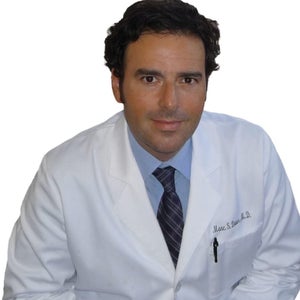

Marc Dauer, MD
Verified
Board Certified Hair Restoration Surgeon
Board Certified Hair Restoration Surgeon
Marc Dauer, MD located in Los Angeles is a leader in permanent Hair and Eyebrow restoration and hair transplants utilizing FUT and FUE methods to achieve the most natural results possible. He has been an M.D. for over 15 years devoted exclusively to Hair and E
Asked By: Resourceful557298
ANSWER
I recommend not stopping finasteride at all with a hair transplant and stopping minoxidil for 1 week prior to the procedure and then re starting 2 weeks after the procedure
Asked By: tipala
ANSWER
I typically try to de-emphasize a cowlick when I am performing a hair transpant. Since the surgeon controls the angle and direction of the hair it is possible to do so.
Asked By: deank
ANSWER
The transplanted hair should not fall out unless there are other medical issues casing this. Usually the deterioration of hair is from continued loss of native hair. This loss of native hair can be slowed down by using minoxidil and finasteride either topically or orally.
Asked By: Original296035
ANSWER
Yes transplanted hair will usually grow through a scar. It will have a lower growth rate than with healthy tissue, but a 50-60% growth rate through a scar can be a reasonable expectation.
Asked By: TheNaisrep
ANSWER
Typically after an eyebrow transplant there is significant swelling and bruising around both eyes for approximately 4 to 5 days. Some individuals have slightly less swelling and bruising and some slightly more, but this is the average.
Asked By: brittlynn1406
ANSWER
Typically the hair for an eyebrow transplant is taken from the scalp. Because of that, the hair transplanted to the eyebrow maintains its color and character from the scalp. That also means that it will continue to grow exactly like scalp hair. After an eyebrow transplant using scalp hair, you can keep the eyebrow hair as long or short as you wish.
Asked By: didi234
ANSWER
After two weeks post eyebrow transplant it is OK to use eyebrow pencil or powder. Regular facial cream may also be used in the eyebrow area after two weeks post procedure.
Asked By: Jaynine9
ANSWER
Typically most of the transplanted eyebrow hairs shed within 2 to 4 weeks post procedure and begin to grow at approximately 12 weeks post procedure. At five months post procedure we typically see about 50% of the result and the full result at nine months post procedure. It is very important to understand prior to undergoing an eyebrow transplant procedure that when the donor hair is taken from the scalp the new eyebrow hair will be the exact color and character of the scalp hair. The scalp hair that is transplanted to the eyebrow does not become more like eyebrow hair it maintains its character even after the transfer to the eyebrow region. In patients with very coarse hair sometimes it is beneficial to perform Follicular Unit Extraction and harvest finer hairs from lower on the neck. Most importantly, it is imperative when choosing a surgeon that you choose someone with extensive experience performing eyebrow transplants. An experienced hair transplant surgeon is not necessarily an experienced eyebrow transplant surgeon. Orthopedic surgeons fix broken bones but you wouldn't have an orthopedic surgeon fix your broken nose, which is a bone. A plastic surgeon would fix your broken nasal bone. The same is true for eyebrow transplants. Choose a surgeon with a multitude of before and after photo results without make up that you think look natural.
Asked By: abraham8412
ANSWER
There are many different types of alopecia. The term alopecia is a broad based term meaning hair loss. There is alopecia secondary to trauma. There is also alopecia secondary to inflammatory processes or autoimmune processes. Typically eyebrow hair loss secondary to inflammatory processes or trauma are amenable to eyebrow transplants. The growth in these cases maybe less than a typical result because of the scarring in the skin, but we still see improvement and growth in these patients. Patients with alopecia secondary to auto immune processes sometimes have good results and other times not. It is important to know the exact cause of the alopecia prior to performing an eyebrow hair transplant. It is also important that the patient understands the risks and the potential outcomes prior to undergoing the procedure.
Asked By: karimkimo
ANSWER
There are many different types of alopecia. The term alopecia is a broad based term meaning hair loss. There is alopecia secondary to trauma. There is also alopecia secondary to inflammatory processes or autoimmune processes. Typically eyebrow hair loss secondary to inflammatory processes or trauma are amenable to eyebrow transplants. The growth in these cases maybe less than a typical result because of the scarring in the skin, but we still see improvement and growth in these patients. Patients with alopecia secondary to auto immune processes sometimes have good results and other times not. It is important to know the exact cause of the alopecia prior to performing an eyebrow hair transplant. It is also important that the patient understands the risks and the potential outcomes prior to undergoing the procedure.
Dr. Marc Dauer continues to receive overwhelmingly positive reviews for his expertise in , , and procedures. Patients consistently praise his professionalism, attention to detail, and the natural results he achieves. Many highlight his caring demeanor and the thoroughness of his staff. His work is described as artistic and meticulous, with a focus on patient satisfaction and realistic expectations.