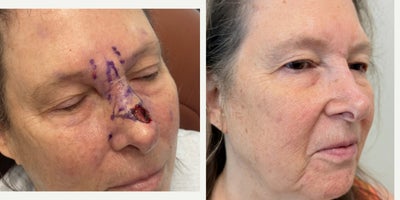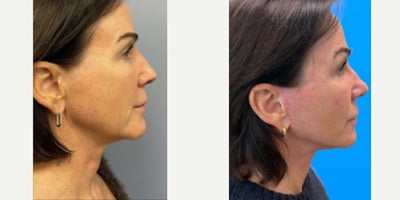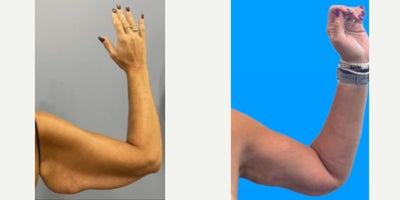

Andrew M Bonett MD is Board Certified in Plastic and Reconstructive Surgery. He specializes in both reconstructive and cosmetic plastic surgery, with specific interests in reconstruction after breast and skin cancers, including Mohs reconstruction. His experie
Asked By: foozball
ANSWER
It looks like most of the skin laxity is central in your photos, so keeping the incision shorter than a fully tummy tuck actually might work in your favor here. The real difference is the degree of dissection and how much of a change you hope to see above the belly button. It sounds like your surgeon is suggesting what some of us might call an "extended mini TT." Small contour irregularities are always a risk after liposuction and/or body contouring surgery but from what I can tell this is not a bad plan.
Asked By: Kylie25
ANSWER
At 4 weeks there will likely be a very thin, immature capsule film starting to form. It is likely so thin at this point that there is no need to worry about removing every last bit of it. It would likely cause more damage than benefit to be aggressive with capsule removal at this point. Also, being only 33 years young, your skin has good elasticity and will likely bounce back pretty nicely. Of course there is a risk it got a little stretched out but unlikely to a significant degree. Good luck!
Asked By: RookieRookshire
ANSWER
Hi, good question. This is a pretty common outcome after any reduction or lift and even happens without the significant weight loss you mentioned. A lot of it has to do with the way the skin incisions were designed and how much lift was required during the reduction. There are other variable during the healing process as well, such as swelling and tension differentials at different points around the circle. We try to distribute these forces equally but there are a lot of variable throughout the surgery and healing process. The good news is you actually have a relatively good shape to the areola that can typically be fixed with a small scar revision under local anesthesia in the office. It may be worth the revision, but remember, most natural nipples and areolas are not perfectly round to start with
Asked By: Nadia_
ANSWER
Hi Nadia_, based on what you are describing and what I can tell from the photos, it is a difficult situation with a couple limiting factors. First, now that the nipple position is asymmetric, it is nearly impossible to attain symmetry without some form of a lift, even if just a small donut-type lift. Secondly, you desire more cleavage but currently have implants under the muscle which can push them away from center and make more cleavage difficult. Lastly, it seems that you are rather fit and don't have much fat elsewhere that would be available for fat transfer to the breast. Sometimes doing a little fat transfer just to the inner and upper breast can help with that last little bit of cleavage. I do agree with the opinion that a transition to subfascial would help improve cleavage and be less detrimental to your weightlifting. However, you need to be careful because the more you push the implants toward the middle, the more the nipple position can be displaced outward. Something has to give in this situation, and it is up to you and your surgeon to discuss these pros and cons and decided what meets most of your needs.
Asked By: hema2
ANSWER
Hi @hema2, the short answer is no! The main issue with doing these things close together are going to be risk of blood clots. Long surgeries such as a mommy makeover can have a slightly higher risk of blood clot formation, especially if you already have more risk factors. One of the biggest preventable risk factors, though, is recent orthopedic surgery. Since these are all elective surgeries, I would just make sure you space everything out to decrease your risk. I would say at least 3 months apart. You also should consider your "down time" for each. Most people don't want to jump into another elective recovery period when they are just getting back to more activity.
Asked By: mainemom
ANSWER
Hi @mainemom, I do think you should have your previous surgeon (or a new one if they are unavailable) take a look. I usually see my patients at least annually to see what natural changes are occurring. Most commonly there will be changes to the soft tissues (breast tissue) that occur around the implant, such as the "waterfall deformity" that you mentioned. Separately, the implant can have issue with capsular contracture, or worsening scar tissue that make it tighter, change the shape, or affect the position of the implant behind the breast tissue. One or both of these things could be contributing to the changes you have seen over the last 11 years. The last thing to consider is that if you silicone gel implants and have never had imaging, then you are overdue for either an ultrasound or MRI to see if the implant is still intact or ruptured. This is the FDA recommendation. It's not an emergency if the implant has ruptured, but at least you know it's time for an exchange. Whether you do another lift at the same time would be a cosmetic concern and up to you and your surgeon
Asked By: Fabulous581753
ANSWER
That's too bad that you had to have double jaw surgery after a successful rhinoplasty. As you have already experienced, manipulation of the underlying skeleton completely changes the foundation that the three-dimensional nose sits upon. There are multiple rhinoplasty techniques that can be used to improve the things you don't like, but it is imperative that the orthognathic/double jaw surgeries are complete first. Secondly, I'm not sure if you had the septoplasty covered by insurance but a secondary rhinoplasty would likely be considered fully cosmetic. You'll just need to talk with your surgeon about the particular things you want to correct, and he/she will explain how they can achieve it.
Asked By: Brightjuniper
ANSWER
6 months after a face or neck lift, most of these irregularities that would be self-resolving would typically have done so by now. Sometimes massage can help, but assuming you have already tried massaging the scar, there is a good chance it won't improve until it is released surgically. Based on the location, it might be accessible by using an incision concealed under the chin instead of opening up the whole facelift incision again.
Asked By: Diligent687559
ANSWER
It is difficult to say for sure without measuring in person, but the angle of the photos lead me to believe that you are already a borderline lift candidate. If you downsize the implant at all, it very well may push you into the category of needing a lift for sure. If you are still borderline (mild ptosis or low nipple position) then you might be able to do the donut lift only. However, keep in mind that sometimes trying to get away with a donut when a lollipop is needed can lead to a thickened scar that is not very well hidden anyway. It is best to let your surgeon determine which lift pattern is best, unless you are willing to tolerate a slightly lower nipple position. The other option if it is a borderline call is to simply do the exchange and see how you feel about the nipple position postop. Sometimes a small donut lift can even be done under local anesthesia in the office.
Asked By: Glorious879077
ANSWER
It's not terribly uncommon to have a hypertrophic, or thickened, scar after a tummy tuck. One of the biggest risk factors for this is a wound on high tension. During a scar revision where your surgeon simply cuts out the scar and closes it again, there is much less tension on the incision during healing. This is why it is usually more successful. One of the side effects of steroid injection is tissue atrophy which can cause indentations as well. You can attempt lasers for the broken blood vessels and the scar itself, but it won't help with any indentations. That is why a full scar revision may be the best bet. It can often be done under local anesthesia without going back under