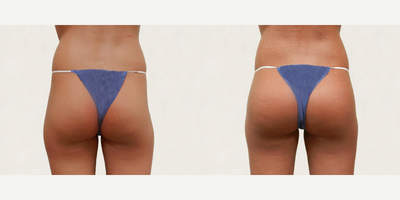
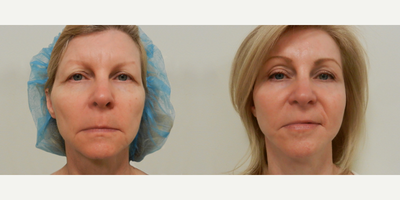
Dr. Wiener and his staff are dedicated to obtaining the finest results possible in aesthetic surgery, as well as providing the best in personalized individual care. We also specialize in providing in-depth consultation, addressing your concerns and expectations to make sure you feel comfortable about the procedure every step of the way.
Asked By: BBLdoll2015
ANSWER
Hello, and thanks for this very good question. The most likely answer is that there was always some degree of cellulite/dimpling there to begin with, but it wasn't obvious. The increased buttock volume from your fat transfer pushing the tissue out caused these irregularities to become more obvious, and maybe even enhanced them. It is unlikely that the fat transfer actually caused cellulite. Both cellulite and dimples occur because of irregularities in the length of fibers called "septa" that run from the undersurface of the skin down to the fascia (covering of the muscle). When the fibers are all of similar lengths, the fat in between the fibers is spaced out in a smooth, uniform manner. When the fibers are of different lengths, the fat in one "compartment" bounded by fibers all around it may be lower or higher than the compartment of fat next to it. This causes the irregular, bumpy look to the skin we see in cellulite, and if the fibers are all shortened in a larger area compared to the surrounding fibers, it causes a dimple (also likely a form of cellulite). This, unfortunately, has to do with your genetics more than anything else, because even thinner people can have some cellulite. However, exercise and hydration can improve things to some degree. There are creams and procedures involving rollers and suction that have been used for years, but results are transient, and they do not cure the condition. Various other procedures involving lasers and/or cutting of the fibers beneath the skin (to allow the fat compartments to equalize and smooth out) have also been used for years with unpredictable results.I tell my patients (and there are many with cellulite and dimpling) that fat transfer (BBL) will make their buttock fuller and improve their figure, but it will not smooth out cellulite and dimples, and could even enhance them. I do, however, perform limited "subcision" (cutting of the shorter, tighter fibers) during fat transfer procedures where there are deeper dimples. If it is done carefully (with a small cannula with a small forked blade on the end) deeper dimples can be safely softened and partially or completely smoothed out. Too much subcision, however, could lead to irregularities that are even worse than the dimples.There are two procedures which may have some value. One is Cellulaze, which uses a laser to cut the fibers, and another is Cellfina, which uses a wire to uniformly cut the fibers in a given area. Both are done under local anesthesia. I have no experience with these treatments, but I know they can be successful, especially in limited areas.I hope this helps.
Asked By: myangel14
ANSWER
Hello, and thanks for the question and photo. First, it is still fairly early after your procedure, and it is normal to have areas of swelling or firmness. It may take a few more weeks, or even several months for all of this to resolve and soften.This area in particular shows more significant edema (swelling) within the skin, creating what we call a "peau d'orange " effect (orange peel), and, again, is not unusual following liposuction. There also seems to be slight discoloration beneath the skin, suggesting a possible small amount of additional bruising which could mean some blood collected in the area. This could be a small hematoma, which would also explain the skin edema. You may also feel some additional firmness in the area if it is in fact a small hematoma. This too should resolve with time. Warm compresses using a washcloth (no heating pads of microwave heated pads) can be done several times a day to increase blood flow to the area as well as some gentle massage ( or more specialized lymphatic massage) to help things get better faster.I hope this helps.
Asked By: Letatonima
ANSWER
Hello, and thanks for the question. Most seromas, once they have resolved, collapse and the underlying space fuses together without leaving a significant bulge in the area. However, some seroma cavities do develop thicker walls. This scar tissue may be thick enough to create a contour problem. In other cases, the cavity never really completely collapses, and there is a small amount of fluid that always occupies the space (but not enough to drain with a needle). An ultrasound exam may demonstrate these thickened areas. If there is still some excess fat on the abdominal wall, this could also be a factor. It may ultimately be easier to liposuction some additional fat over these more prominent areas than reopen the abdominal scar and remove the scar tissue from the seromas.Discuss these issues with your plastic surgeon (or another board certified plastic surgeon). Most likely, there will be a way to get you flatter and improve your contour.I hope this helps!
Asked By: FelixtheKitten
ANSWER
Hello, and thanks for the question. As you can see from other doctors' answers, there is wide variation in the views on this topic. One issue is, there really haven't been any good, scientific studies done regarding pressure on newly placed fat in the buttock, so we really don't know for sure when pressure can safely be applied without affecting the survival of the fat cells. The main issue is the fact that pressure from sitting could squeeze out the blood flow to the area of the buttock your sitting on. Decreased blood flow means less oxygen, and less oxygen means potentially less fat surviving. How long it takes for the fat to obtain blood flow and survive is also a question. A typical skin graft takes from 3-5 days "take" as it goes through a process of getting oxygen from the surrounding tissues and finally developing its own connection with the tissues in the form of new blood vessels. This is when the graft is truly stable and should survive. If we apply that to fat cells, you may only need to stay off the buttock for 5 days in order for the fat to be alive and stable. However, I typically tell my patients to refrain from sitting, and especially laying or sleeping on the back (which places the most pressure directly on the transferred fat) for two weeks just to be extra careful. There is no exact, scientific evidence that this is necessary, but it has worked well for me and my patients over the years.I hope this helps!
Asked By: truth42
ANSWER
Hello, and thanks for the question. I completely understand your concern regarding the eventual size of your buttock after fat transfer. Many of my patients also want a result that is as full and round as possible. Sometimes this can be limited by the amount of fat that we can harvest, since, after removing the fluid and any unusable portions, the amount of pure, usable fat is only about 30-40% of what we originally remove with liposuction. You did not send any photos, but it is likely that, with your measurements and weight, this will not be a problem.Other issues that could limit your size include the overall dimensions of your buttock and how much tissue you have currently. The fat is injected in very small amounts throughout the muscle and the overlying fat. Each droplet of fat has to be surrounded by your natural tissue in order to receive oxygen and survive. Fat cannot be crowded, or placed under extreme pressure, because it won't survive under those conditions. So there is a definite "endpoint" for every fat transfer based on how much initial tissue there is to inject into. A board certified plastic surgeon with experience in fat transfer to the buttock would be able to give you a better idea of how large you could be after a physical exam.Severe dimpling or cellulite of the buttock may also limit the size of your buttock, due to the fact that the skin is held onto the muscle surface by fibers called "septa". The overlying skin may not expand easily if you have severe dimpling. Some of the fibers can be released (cut using a special cannula under the skin), but only a few, or the skin could lose support and sag off of the muscle, creating major contour problems. Again, an exam by a board certified plastic surgeon would be the best option.I hope this helps, and best of luck!