CAPS | Plastic Surgery, Dermatology, MedSpa, & Wellness Center- Upper Arlington
5005 Arlington Centre Blvd., Upper Arlington, Ohio, 43220
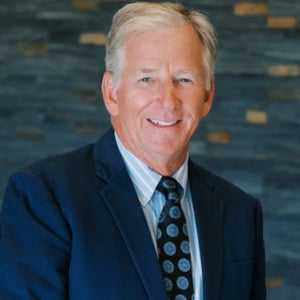
Board Certified Plastic Surgeon
Dr. Timothy Treece co-founded CAPS in February 1997 with a mission to redefine the field of plastic surgery and aesthetics. Drawing on his background in visual arts and his dedication to patient care, he takes pride in helping individuals achieve results that



Asked By: ElizabethP8
ANSWER
Great question! You can indeed have a facelift in office under oral and local anesthesia. There are factors to consider when deciding if this option is right for you. Your health history, and risk factors all play a part when determining if an in office, conscious sedation facelift is right for you. Your preference also plays a part in deciding whether or not this option is best. Often times, an in office facelift takes around four hours with a medication re-dosing mid procedure. You are awake and able to get up and use the restroom mid-procedure as well if needed! Most patients are extremely comfortable and often times with medication and local numbing, are able to fall asleep during the entire procedure. I cannot speak to other practices, but in my practice, general anesthesia can only be administered at the surgery center and not in our office setting. The percentage of facelifts in office versus at the surgery center under general anesthesia is constantly changing, as it is solely dependent on the patient and their safety. As always, I highly recommend discussing this in depth with your board certified plastic surgeon to determine which option is best for you!
Asked By: cwuila32
ANSWER
Thank you for your question! Without examining you in person, it is very hard to determine if a facelift would be able to restore your cheek volume alone, or if you would also need a fat transfer. It is true, that often with a facelift and the re-positioning of the muscle layers , it can indeed give you some volume improvement in your cheek region. However, often times your best result comes with a facelift in conjunction with a fat transfer. It is always my recommendation to meet with a board certified plastic surgeon in person to determine what procedure would fit best for you!
Asked By: 9710becky
ANSWER
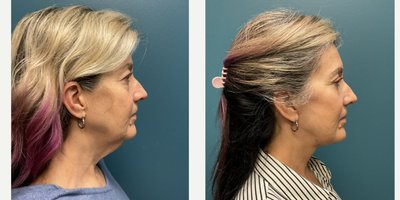
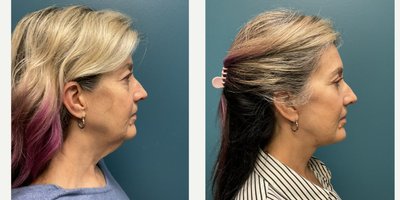
Thank you for your question in conjunction with pictures! You are an excellent candidate for a Facelift, as well as a Necklift. Often times, these procedures go hand in hand with a procedure referred to as a SMAS Facelift, which targets multiple areas including sagging skin, and the muscular structure of the face. Without examining you in person, I believe a SMAS Facelift, in conjunction with Submental (under the chin) Liposuction would give you your best results. As always, it is best to meet with a board certified plastic surgeon to help develop a plan that best fits you!
Asked By: auuilo34
ANSWER
Thank you for your question, and images! Upon review of your images, I believe you would be a great candidate for a fat transfer procedure. You may also benefit from filler to achieve your goal of facial symmetry, if fat injection does not appeal to you. By adding volume where needed, you can achieve both symmetry, as well as facial tightening. As always, it is best to meet with a board certified plastic surgeon in your area, and they can help develop a plan that fits best for you.
Asked By: WinterWonderland17
ANSWER
Thank you for this question! Most offices are closed at this time, as most of the surgeries provided are considered non-essential. Offices are doing whatever they can to ensure the safety of their patients. You may want to research offices in your area, and beyond who are offering virtual consultations. As of right now a lot of offices are offering virtual consultations at a reduced cost! This is great because you can get a consultation with a board certified plastic surgeon that you may, or may not have had the chance to meet with originally. It is a great way to grow your knowledge base in regards to the procedure that fits you best. This also gets you in a great place to schedule an in person consultation, or proceed with surgery once the COVID-19 restrictions are lifted!
Asked By: Hello1899
ANSWER
Great question! You will see that most surgeons will refer you back to your original surgeon. However, if it is an issue of trust on your part, and you are not wanting to continue the relationship with your current plastic surgeon, there are surgeons out there who would be willing to take on your revision case. Often times, it would be considered an entirely new process, with a new surgeon. The new surgeon would need your surgical note from the previous physician to be brought up to speed on the procedures performed. After that, you then most likely will have consultation fees, updated pictures taken, and a new surgical plan with the new physician to get you on the path to looking and feeling your best!
Asked By: tem_eee
ANSWER
Yes, it is common. Reduction techniques involve removal of breast tissue down to the margin of the rib cage. The sensory nerves that run from the ribs, to the breasts can be temporarily injured or bruised and the muscles of the chest wall can also be minimally injured. It is not uncommon to have some discomfort on the rib cage for up to four to six weeks after surgery. When this does occur, it is typically very mild.
Asked By: lisa.777
ANSWER
Surgeons are using micro-autologous fat transfers routinely to supplement the volume of the lower lids. The way we have approached lower eyelids has changed dramatically in the last 10 years. We used to remove fatty pockets and tighten the orbiculous muscle. Now, we are realizing, especially with a lot of volume metric studies, that a big part of the risk can be avoided and a more natural result can be obtained by filling this area to soften the contour between the lid and the cheek. This gives a more youthful look and a more predictable result with a permanent change. We over inject the fat because we know that only about 50% of the fat graft will last permanently. This has become a mainstay for the surgeons who do a substantial amount of lower eyelid surgery.
Asked By: Ev3345
ANSWER
Yes, it is perfectly fine to have a Blepharoplasty and a MACS lift a couple of weeks after Botox. Optimally, especially for a Blepharoplasty, we want to operate when there is no neuromodulator present in the forehead. The presence of Botox can slightly change the upper lid and brow relationship. Typically, the surgeon likes to know where the area naturally sits without any neuromodulator, such as Botox, to provide an optimal result. Botox typically takes four months to wear off. You should plan to discuss this with your surgeon prior to any procedure.
Asked By: imtrying
ANSWER
Silicone injections can complicate any subsequent surgery, but it depends entirely on where they were made. If the injection was made very deep into the area, just above the bone, then there may be very little interaction with a Facelift incision. If the injection was made in the subcutaneous pane, then it could cause contour irregularity. It is very important that patients disclose exactly what they had done in the past to avoid any surprises in the operating room.
Mention RealSelf to redeem.
By Choosing Dr. Treece through Realself We are offering you a Discounted Consultation Fee of $50.00. (Consultation Fee is typically $100.00) This is a Complimentary Discount for our RS Customers
REDEEM OFFER~ SCHEDULE YOUR BREAST AUGMENTATION CONSULTATION WITH DR TREECE Choose one complimentary treatment or products offered below when you select any Natrelle® gummy implant for your breast augmentation procedure.* • Botox • CoolSculpting • SkinMedica® HA5® Rejuvenating Hydrator • SkinMedica® Sampler Kit
Dr. Timothy Treece has received consistently positive reviews for his expertise in . Patients highlight his professionalism, the supportive nature of his staff, and the outstanding results of his surgeries. Many patients express increased confidence and satisfaction with their appearance post-procedure.