The Plastic Surgery Institute Med Spa - Beverly Hills
465 N. Roxbury Dr., Ste. #1001, Beverly Hills, California, 90210
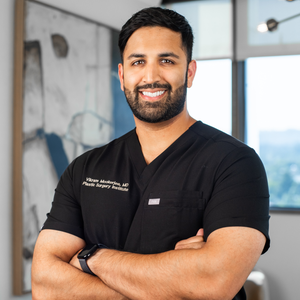
I am a Yale-trained plastic surgeon specializing in cosmetic surgery of the face, breast, and body. I have advanced training in Deep Plane Facelift. My work focuses on natural-looking results and personalized care for every patient. I strive to bring a thought
Asked By: Original665774
ANSWER
Based on your photos, you do appear to have some fullness in the buccal fat pad area. That being said, the fullness in your lower face may be a combination of both buccal fat pad herniation and some mild, early jowling. However, you do not appear to have significant facial laxity, so a buccal fat pad reduction may be a smaller, more conservative treatment option that still meaningfully improves your lower face contour. One way to test whether the jowling has a component of buccal fat pad herniation, is to push the fullness and depress it back into your face. Hold that for a few seconds, then remove your finger. If the fullness promptly springs back into place, it is probably more of just pure jowling. However, if the fullness slowly returns to place, like a sponge unfurling, that is more indicative of buccal fat pad herniation. The key with buccal fat pad reduction, as with any plastic surgery, is all in the judgement of how much to do/remove. If too much fat is removed, it can create hollowness. However, a conservative trim can be a nice way to slim the lower face and improve the overall contour. You are welcome to try RF microneedling, but I do not think it will meaningfully improve the soft tissue contour. It is moreso a tool for skin texture and tone, and promoting collagen production. I would also not recommend Ultherapy to try and address this. An in-person consultation with a plastic surgeon will be very helpful, because they can perform a physical exam and give a better understanding of what are the causes of the lower face fullness. And, based on their findings, provide treatment recommendation options. Hope this helps, good luck!
Asked By: Reliable914680
ANSWER
Based on your photo, you actually appear to have eyelid ptosis. This is when the eyelid starts to droop and begins to cover the iris (the colored part of the eye). It appears as though the right eyelid is drooping slightly more than the left. This is also indicated by a higher supratarsal crease, or eye fold, on the right side. To address this, you can discuss ptosis repair surgery with a plastic surgeon. This is a surgical procedure where the eyelid is lifted to correct drooping. They may need to perform a slightly different amount of lift on either eyelid, and perhaps raise the right eyelid slightly more, in order to improve your existing asymmetry and try to make the lids match more closely. Hope this helps, good luck!
Asked By: teddy3166
ANSWER
Sorry you are dealing with this issue. In general, there is no way to completely remove a scar with a revision - you are simply trading the old scar for a new one, that is hopefully more to your liking. Scar revision is typically considered when there is abnormal scar healing, such as a hypertrophic scar. Based on your photos and the information you provided, it seems that what bothers you is the scar length and the scar visibility, particularly the portion of the scar that sits lateral to the natural eye crease. It looks like the scar itself may be hypopigmented and whitish in color, increasing its visibility. For a non-invasive option to reduce scar visibility, you can consider tattooing the scars. A tattoo artist with experience in medical scar camouflage can improve the color match between the scar and the surrounding skin, thereby reducing its visibility. Hope this helps, and best of luck.
Asked By: Anonquestion
ANSWER
This is always a tricky question to answer without an in-person consult, because a lot depends on your goals and the status of your abdominal skin. In general, liposuction can reduce overall fullness and enhance contours, but it does not tighten skin on its own. So, if your goal is just to reduce the amount of fat and slightly enhance the shape of the lower abdomen, you could be a great candidate. That being said, many plastic surgeons would recommend combining the liposuction with some type of skin tightening device to avoid creating loose skin. However, if you want a very tight and toned "washboard" type of abdomen, a "tummy tuck" or abdominoplasty procedure may be the better option. A tummy tuck removes not only excess fat but also loose skin, and it also allows the surgeon to tighten the abdominal muscles if they have developed any laxity over the years. I would encourage you to have a consult with a plastic surgeon in person to discuss more. Hope this helps, and good luck!
Asked By: veronica.33
ANSWER
Hi - to answer your questions: 1. Most surgeons would prefer low-pressure, manual handheld liposuction as an atraumatic liposuction technique for harvesting fat grafts for the face, in order to maximize viability of the fat cells. However, after the fat grafts are harvested, the rest of the arm liposuction could certainly be performed with AirSculpt 2. It is reasonable to combine these procedures, provided that you are healthy enough to undergo general anesthesia for the projected time in the operating room 3. Facial fat grafting and/or upper blepharoplasty should not make a facelift in the future more difficult Hope this helps, and good luck!
Asked By: Straightforward607805
ANSWER
Sometimes, under eye bags have more to do with genetics and anatomy rather than age. Based on your photos, lower eyelid blepharoplasty with fat repositioning would be a surgical treatment option to address your lower eyelid bags. This may need to be combined with additional facial fat transfer to the midface, to enhance the volume in that area. Finally, an ablative resurfacing laser applied to the lower eyelid skin may also help with the skin texture and tone. All three of these procedures can typically be combined in the same operation. An in-person consultation with a plastic surgeon will help them determine if you are indeed a candidate for these procedures, based on your anatomy and your goals. Hope this helps, and good luck!
Asked By: Easygoing673040
ANSWER
For upper eyelid scarring, it is reasonable to attempt nonsurgical treatment first such as steroid and/or 5-Fluorouracil injections. If these do not alleviate the scarring, surgical options would be to perform a scar revision (excising the existing scar and re-suturing it closed), or potentially a Z-plasty. The correct treatment depends on whether it is simply a thickened scar, or whether there is true tethering/banding. An in person consultation with a plastic surgeon will help to determine which treatment option may be most appropriate for you. Hope this helps, and good luck!
Asked By: Maria Davids
ANSWER
In the right candidates, it is possible to achieve significant rejuvenation of the face without a submental incision. A well executed deep plane facelift can still significantly lift the midface, lower face, and jowls from the lateral approach alone. Sometimes this is paired with a little bit of submental liposuction under the chin. Typically, these are patients that are thinner, on the younger side, and have less overall signs of aging. Forgoing central neck surgery starts to impact facial improvement more if the patient has a heavier neck with more significant aging. An in person consultation with a plastic surgeon will help you determine which plan is best for you, based on your goals. Hope this helps, and good luck!
Asked By: MaryTho
ANSWER
Hi, sorry to hear you are dealing with this, unfortunately it does happen in some cases. Micro needling and laser are unlikely to improve scar hypopigmentation. Tattoo is certainly an option and can be a non invasive way to blend the appearance of the scar. However, I would make sure that your tattoo artist has experience with facelift scars and can show you some of their results. The other option is a surgical scar revision. This would involve cutting our the hypopigmented scar and then advancing the facelift flap back to the ear. There may be a need to advance the deeper tissues as well, so avoid placing tension on the new skin to skin closure. I would encourage you to schedule an appointment with your plastic surgeon to discuss your options and the pros/cons of each approach. Hope this helps, and good luck!
Asked By: Stuart3
ANSWER
Everyone recovers differently, so it's difficult to give specifics. However, if you are asking for a rough timeline, I counsel my facelift patients generally by about 3 weeks postop a good amount of the swelling had subsided, and you can begin to appreciate some of the new contours. To truly see the results, it usually takes about 3 months, and that is why I commonly counsel patients to give themselves about 3 months of recovery before important social events such as weddings, graduations, etc. The results continue to refine over the next year. Hope that is helpful, and good luck!
Dr. Vikram Mookerjee consistently earns praise for his attentive listening, realistic expectations management, and exceptional patient care. Patients highlight his ability to deliver natural-looking results through skilled techniques like and . His dedication extends beyond surgery, with personalized follow-up care and direct involvement in patient recovery. The provider's calm communication style and genuine concern for patient well-being create a stress-free experience that leaves patients feeling confident and satisfied with their outcomes.