Show more
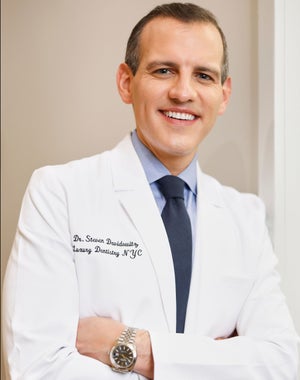
Dr. Steven Davidowitz, better known as Dr. D, is a Manhattan cosmetic dentist celebrated for his expertise in porcelain veneers and smile makeovers. Having completed over 500 veneer smile transformations, he is known for delivering natural-looking, highly cust
Asked By: moe2026
ANSWER
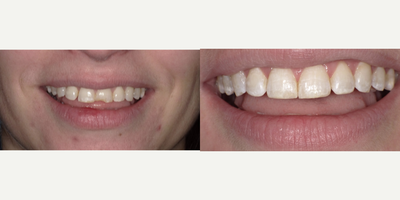
Based on your photos, I do see several concerns with the shape and contours of these temporaries. While I can’t determine from photos alone exactly why they were made this way, I don’t think your question is unfounded. Temporary veneers serve an important purpose beyond simply protecting your prepared teeth. They are essentially a test drive for your new smile. They allow both you and your dentist to evaluate the length, width, contours, phonetics, bite, and overall esthetics before the final porcelain veneers are fabricated. This is one of the biggest advantages of wearing temporaries. That said, temporaries also have limitations. They are made from acrylic or bis-acryl materials, are hand-finished, and will never have the same precision, translucency, surface texture, or polish as the final porcelain restorations. Even taking those limitations into account, I see several areas that could likely be improved. The incisal edges appear somewhat uneven, the embrasures between the teeth are not well developed, and the overall anatomy looks rather flat and blocky. The contours also don’t appear as refined as I would expect if these were being used as a true esthetic prototype. This raises another possibility. Some dentists fabricate temporaries simply by duplicating the patient’s original teeth to protect the preparations rather than using them as a true smile design. If that’s what was done here, these may not be intended to represent the final shape of your veneers at all. I would ask your cosmetic dentist one simple question: “Are these temporaries intended to be a prototype of my final veneers, or are they simply provisional restorations copied from my original teeth?” The answer will help set the right expectations. If these are meant to guide the final design, I would recommend discussing the specific changes you’d like before the porcelain is fabricated. It is far easier to modify the design at the temporary stage than after the final veneers have been completed. A good cosmetic dentist welcomes this feedback, as the temporary phase is often where the best final smiles are created.
Asked By: Newporter
ANSWER
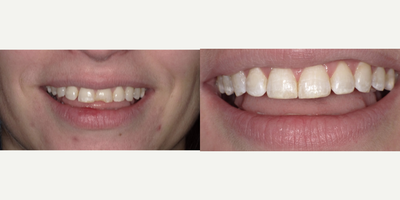
Based on your photos, I can understand why you’re concerned. While I can’t diagnose from images alone, your temporary restorations actually appear to have a pleasing overall shape. However, if the final no-prep veneers feel significantly bulkier—especially around the gumline of the canines—and you notice a visible fullness in that area, your concern is reasonable. With no-prep veneers, the dentist is adding porcelain to the existing tooth rather than creating space by removing enamel. This means there is a limit to how thin the restorations can be while still masking discoloration or replacing lost enamel. On some patients—particularly those with naturally prominent teeth or canines—this can result in restorations that are slightly over-contoured. A few things to keep in mind: * It is normal for veneers to feel different for the first few weeks. Your lips and tongue are very sensitive to even tiny changes. * However, you should not simply accept restorations that look or feel unnaturally bulky if they continue to bother you after an adjustment period. * The area around the gumline is especially important. Excess contour can make the teeth appear puffy, trap plaque, and sometimes contribute to gum inflammation. * In many cases, minor adjustments and polishing can improve the emergence profile. If the porcelain itself is fundamentally overbuilt, however, significant reduction may compromise the restoration’s strength or esthetics, and remaking the veneers may be the better option. One thing I always discuss with patients considering no-prep veneers is that preserving enamel is a tremendous advantage, but it comes with tradeoffs. Not every patient is an ideal candidate. Sometimes minimal-preparation veneers actually produce a more natural, less bulky result because a small amount of enamel reduction creates room for the porcelain. I would recommend discussing your concerns with your cosmetic dentist and specifically pointing out the canine gumline contours that bother you. Ask them whether they believe the restorations can be conservatively refined or whether the contours are inherent to the no-prep design. An experienced cosmetic dentist should be able to explain the rationale and, if necessary, discuss options for improving the final result.
Asked By: kwalk14
ANSWER
Based on your photo, this appears to be a very small enamel chip on the facial (front) surface of your front tooth. While I can’t confirm that from a photo alone, I don’t see anything that suggests a large fracture or an urgent situation. The good news is that a small chip like this typically does not continue to spread on its own unless the tooth is subjected to additional trauma, excessive biting forces, or grinding/clenching. The fact that you can feel it with your tongue is very common—even tiny imperfections can feel much larger than they look. If the chip bothers you cosmetically or feels rough, treatment is usually straightforward: * Smoothing/polishing: If the chip is very shallow, your dentist may simply polish the area to remove the sharp edge. * Composite bonding: If more structure is missing or you want the tooth restored to its original contour, a small amount of tooth-colored composite can usually be placed in a single visit. * No treatment: If the chip is stable, painless, and not noticeable, observation is also a reasonable option. Since you’ve mentioned having composite bonding on this tooth previously, it’s important for your dentist to determine whether this is a new enamel chip or whether it involves the edge of the existing restoration, as that may influence the best repair approach. If you also grind your teeth at night or have a history of chipping teeth, ask your dentist whether a nightguard would help prevent future wear. Overall, this looks like a problem that is very treatable and is unlikely to require anything more than conservative care. I’d recommend having it evaluated at your next dental visit—or sooner if it becomes painful, the chip enlarges, or you notice sensitivity.
Asked By: Enthusiastic998313
ANSWER
At 2 weeks, some degree of “newness” is normal but what you’re describing, combined with your photos, suggests this may be more than just an adjustment phase. The veneers appear over-contoured and somewhat bulky, particularly on the facial surfaces and incisal edges. When restorations are built out too far, they can feel prominent against the lips and unnatural when speaking or biting and that typically does not resolve with time alone. One important consideration in cases like this is tooth preparation. If the underlying teeth were under-prepared (not reduced enough), the lab or 3d printed design often has no choice but to build the veneers outward to achieve strength and esthetics resulting in that bulky look and feel. In those situations, simply adjusting or thinning the restorations has limitations and may compromise the material. While minor contouring can help in select cases, there’s a threshold where further reduction can negatively affect: • Surface integrity and long-term polish • Strength and fracture resistance • Overall esthetics and proportions For that reason, when bulk is related to both over-contour and insufficient reduction, a redo is often the more predictable and ideal solution. I would recommend returning to your dentist for a candid discussion. If they agree the restorations are overbuilt, a remake with proper reduction and a more refined design (improved facial profile, natural line angles, and better incisal anatomy) should provide a significantly more comfortable and natural result. Bottom line: If veneers still feel bulky at 2 weeks and appear over-contoured, it’s reasonable to consider this a design/preparation issue, not just adaptation, and a redo may be the best way to achieve the intended outcome.
Asked By: Independent7035
ANSWER
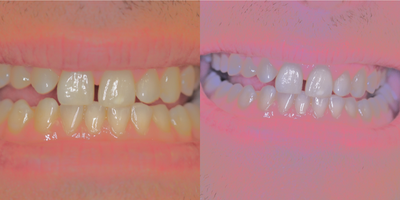
Thank you for sharing your photo and background — that context is very helpful. First, I think you’re asking the right question. When a single front tooth has had composite bonding for years, especially from childhood trauma, the surrounding teeth often change over time as well. In your photo, your non-treated central incisor appears thin with visible craze lines and minor chipping, which suggests it has been carrying additional load for years. That becomes important in long-term planning. While placing a single veneer is technically possible, matching one central incisor to a natural neighboring central can be one of the most challenging procedures in cosmetic dentistry. Even when done beautifully, the natural tooth will continue to age, wear, and potentially discolor differently than the veneered tooth. This often leads to future adjustments or retreatment. For long-term stability and symmetry, I would typically recommend treating the four upper incisors (both centrals and both laterals) with minimal-prep or no-prep veneers. Here’s why: • Symmetry: The two central incisors dominate the smile. Treating both allows us to control shape, width, surface texture, and light reflection so they look harmonious rather than slightly mismatched. • Load distribution: Since your healthy central already shows signs of wear and minor fracture, reinforcing it with porcelain can help protect it structurally. • Aging consistency: Veneers placed at the same time will age uniformly in color and surface texture. • Cosmetic blending: Including the laterals ensures proper transition in width and shade so the smile looks natural rather than having two teeth that stand out. • Long-term maintenance: High-quality porcelain is more color-stable than composite bonding and far less prone to staining. With modern minimal-prep techniques, very little (and sometimes no) tooth structure needs to be removed, especially when you are already planning a gum lift that will help idealize proportions. If the goal is a long-term solution with fewer revisions over time, treating the front four incisors is often the most predictable and stable approach. Of course, final decisions should be made after a comprehensive exam, bite evaluation, and digital smile design to ensure proper proportions and function.
Asked By: kmw11
ANSWER
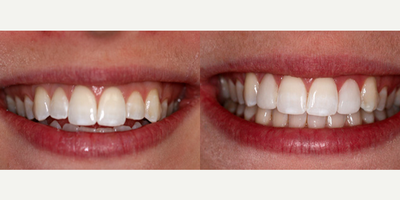
I completely understand your frustration, especially when your temporaries actually looked better than your final veneers. That shadowing or darkness you’re noticing between your veneers is usually the result of technical or design issues, such as: Inadequate tooth preparation that doesn’t properly wrap around the sides of the teeth, leaving visible natural tooth structure or gaps that catch light differently. Spaces or contouring problems between veneers, creating dark “triangles.” Veneer thickness, opacity, or cement shade that fails to mask underlying color evenly. The reason your temporaries looked more natural is that they were likely made as one connected unit, which can mask spacing and light reflection. Once the finals were made individually, any lack of wrap-around or contouring became much more noticeable. In most cases, the only true fix is to redesign and replace the veneers with proper preparation and contouring. A highly skilled cosmetic dentist and ceramist can eliminate the shadows and create seamless transitions between your teeth. It’s definitely worth getting a second opinion from a dentist who specializes in aesthetic smile design — you don’t have to settle for a result that doesn’t make you confident.
Asked By: myrealself210
ANSWER
I completely understand how discouraging that can feel — when your smile doesn’t look natural, it can really affect confidence. Unfortunately, once multiple crowns and veneers have been placed, there’s only so much that can be done to “revise” them without starting fresh. If people are noticing that your teeth look “fake,” it usually means the proportions, color layering, or translucency were not designed to harmonize with your face and natural teeth. Minor adjustments or polishing won’t fully correct that. In most cases like yours, the most reliable way to achieve a beautiful, natural result is to redesign the entire set, ideally through digital smile design, detailed shade analysis, and collaboration with a high-end cosmetic lab. While it’s an investment, a properly crafted new set of veneers and crowns can look completely natural and last many years.
Asked By: julieandrea
ANSWER
Thanks for sharing your story. Matching just one or two front teeth is one of the hardest things in cosmetic dentistry. While a skilled dentist can often improve a composite result, porcelain veneers generally offer more predictable and lasting color stability. Porcelain reflects light more like natural enamel, resists staining, and maintains its brightness over time, especially important when you’re very particular about shade and symmetry. Composite bonding is a good conservative option, but it can lose luster or stain faster, often requiring more maintenance. If you’re seeking the best long-term color match and consistency, a carefully designed pair of porcelain veneers by an experienced cosmetic dentist and ceramist is usually the more reliable solution.
Asked By: Plucky715581
ANSWER
Thank you for sharing your story, it’s clear you’ve put a lot of thought and effort into your oral health, and it’s understandable to be cautious when considering your next steps. Veneers can be a highly effective solution for patients dealing with severe staining, demineralization, or extensive fillings, especially when the goal is to achieve a beautiful, natural-looking smile that lasts. The good news is that when done correctly by an experienced cosmetic dentist, veneers do not have to look fake, bulky, or unnatural. In fact, a skilled provider can design custom veneers that precisely match the shape, size, and character of your natural teeth, preserving the features you love while improving color and uniformity. Since you already have a significant amount of restorative work (fillings) on your front teeth, veneers could be a more stable and aesthetic long-term option than continually polishing or replacing stained fillings. That said, the most important factor is choosing a reputable and highly trained cosmetic dentist, someone who has extensive experience in designing conservative, lifelike veneers using high-quality materials and advanced techniques. A knowledgeable cosmetic dentist will take the time to understand your goals, explain the process clearly, and craft a treatment plan that enhances your smile without compromising what makes it uniquely yours. Wishing you the best as you explore your options, don’t let fear hold you back from the confidence you deserve! Warmly, Dr. Steven Davidowitz Cosmetic Dentist Luxury Dentistry NYC Dr. D
Asked By: ekk620
ANSWER
It depends on the severity of your gum recession. In your situation, it appears healthy enough to move the teeth into a better position and bite prior to grafting. This approach can actually help the graft take better and last longer. When you move your teeth into their ideal positions with Invisalign, it can improve your bite and overall dental alignment. This can create a more stable foundation for the gum grafting procedure. By addressing the alignment issues first, the grafting process can be more effective and have a higher chance of success. However, it's important to monitor your gum health closely during the Invisalign treatment. Regular check-ups with your dentist or periodontist will ensure that any changes in your gum condition are addressed promptly. If you notice any increased sensitivity, discomfort, or changes in your gums, be sure to inform your dental care provider. Ultimately, the decision to proceed with Invisalign before treating gum recession should be made in consultation with your dental professionals. They can provide personalized advice based on your specific dental health needs.
Mention RealSelf to redeem.
- Appointment required. Must mention RealSelf special offer when making appointment. Contact us to make an appointment.
- New Patients only. Consult Appointment Required. Must mention RealSelf Special Offer Promotion when making appointment. Contact us to schedule your appointment.
New Patients only. Consult Appointment Required. Must mention RealSelf Special Offer Promotion when making appointment. Contact us to schedule your appointment.
Dr. Steven Davidowitz is highly praised for his exceptional cosmetic dental services, particularly in , , and procedures. Patients consistently highlight his expertise, friendly staff, and the transformative results of his treatments. His practice is noted for minimal wait times and a welcoming atmosphere.