Dr. Serdar Özateş is an ophthalmic surgeon with over 12 years of surgical experience and more than 8,000 procedures performed. His practice focuses on eyelid surgery, including upper and lower blepharoplasty and revision cases, alongside adult strabismus surge
Asked By: Straightforward291349
ANSWER
A detailed physical examination would be necessary to determine exactly what is creating the line and whether the main component is fat prominence, a tear-trough/infraorbital hollow, skin pigmentation, or the underlying orbital and cheek anatomy. Your expectations are also very important when deciding how much improvement is realistically achievable. At 24, I would generally recommend considering non-surgical options first, particularly if there is no significant skin excess. Depending on the examination, a very conservative amount of filler or a carefully planned, limited fat transfer to the deficient area may improve the contour. Since you have already had a fat transfer without satisfactory improvement, it would be important to understand why it did not produce the expected result before considering another procedure. If surgery is eventually indicated, and the main problem is prominent lower eyelid fat without significant skin excess, a transconjunctival lower blepharoplasty would generally be my preferred approach. This allows the fat to be addressed through the inside of the eyelid without an external skin incision. In some patients, the fat can also be repositioned rather than simply removed to improve the transition between the lower eyelid and cheek.
Asked By: ing23
ANSWER
If the photograph is representative and the lighting and angle are not misleading, the lower eyelid fat bulging does not appear to be very prominent. The contour irregularity you are describing may be more related to the transition between the lower eyelid and the cheek, with a slight hollow underneath the bulge. In this situation, a lower blepharoplasty may not necessarily be the best or most appropriate solution. Depending on the findings during an examination, the contour could potentially be improved with a small amount of fat grafting or, in selected cases, a carefully placed dermal filler to soften the indentation. The ideal approach depends on the anatomy of the lower eyelid, the amount of fat herniation, skin quality, and the depth of the hollow. An in-person assessment would be necessary to determine which option would give you the most natural and balanced result.
Asked By: Bless03
ANSWER
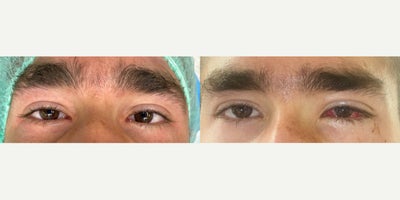
Given your previous lower eyelid reconstruction with a hard-palate graft, I would favor addressing the lesion before it enlarges further. If the lesion is gradually increasing in size and is now contacting or irritating the cornea, removal would generally be more reasonable than continued observation. Considering your surgical history and the location of the lesion, a limited procedure—removing the protruding portion and carefully cauterizing the base without creating a significant eyelid defect—may be a reasonable approach, provided that the lesion can be safely treated in this manner. However, the exact technique should be determined after a careful examination of the lesion, the reconstructed eyelid, and its relationship with the cornea. If there is any clinical suspicion regarding the nature of the lesion, histopathological examination should also be considered. In your particular situation, the goal should be to remove the lesion while preserving the reconstructed eyelid as much as possible
Asked By: reign0000
ANSWER
If the photograph is representative and not misleading due to the angle or lighting, it appears that there may still be some excess upper eyelid skin that could potentially be addressed with a revision procedure. However, this cannot be determined reliably from a photograph alone. Before considering any further skin excision, I would recommend an in-person examination to carefully assess your eyelid function, particularly eyelid closure, as well as the amount of skin that can safely be removed. The most important question is whether the amount of additional skin that can be safely excised would be sufficient to achieve an improvement that meets your expectations. A proper physical examination can help determine this and also identify whether factors other than excess skin may be contributing to the appearance.
Asked By: SpecificBluebird
ANSWER
There appears to be some residual scar tissue beneath the eyelid following the previous surgery. The presence of these lumps may suggest that some of the tissue from the previous chalazion was not completely removed. In my opinion, repeating the surgery to remove the remaining tissue and address the irregularity under the eyelid could help improve your symptoms and the contour of the eyelid.
Asked By: pn00
ANSWER
My impression is that the current eyelid problem may be related to the previous strabismus surgery. Because of this, I would not expect eyelid surgery to give a fully predictable result while the eye alignment problem remains unresolved. In my view, the key issue is to first understand the current alignment in detail and review the information from the previous strabismus surgeries. Only after that assessment would it be possible to judge whether eyelid surgery would be appropriate and what result could realistically be expected.
Asked By: Intuitive163473
ANSWER
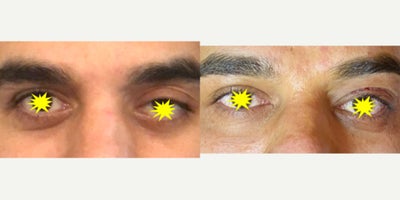
The photo is somewhat difficult to evaluate because your eyes appear to be looking slightly downward, which can make the upper eyelids look lower than they actually are. There may be mild ptosis, but I would recommend additional photographs taken looking straight ahead, ideally from the front and from both sides, before making a more definite assessment. If the main issue is true ptosis, it can usually be corrected surgically. By adjusting the eyelid position, ptosis surgery can create a more open, alert and symmetrical appearance while still aiming for a natural result.
Asked By: Exuberant838025
ANSWER
From the photo, there appears to be some degree of ptosis, which may be contributing to the asymmetry. However, a complete eyelid and eye examination would be necessary to determine the exact cause and severity. Based on this image alone, it does not appear that an orbital box osteotomy would necessarily be required. If the asymmetry is primarily related to the eyelid position, ptosis surgery may be sufficient to improve it significantly. The most appropriate surgical technique would be decided after measuring the eyelid position and levator muscle function during an examination.
Asked By: HelenHarpenden
ANSWER
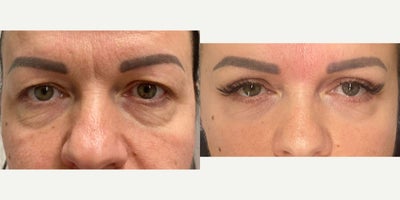
At this stage, I would not expect another CO2 laser treatment to provide a significant or long-lasting improvement, particularly given your previous treatment. The most important step would be to discuss exactly what appearance you are hoping to achieve and assess what can realistically be improved surgically. Based on the photo, I believe you could benefit from a lower blepharoplasty through a skin incision, with conservative removal of excess skin and protruding fat where necessary. An in-person examination would still be essential to assess your lower eyelid support and determine the safest amount of skin that can be removed while maintaining a natural result.
Asked By: Witty239770
ANSWER
Based on your photos, there appears to be some excess lower eyelid skin, so a transcutaneous approach with conservative skin excision may provide a more appropriate and complete result than a transconjunctival approach alone. Regarding the fat, fat repositioning does not appear to be necessary from the photos, as there is no prominent fat prolapse. However, the final decision is best made after an in-person examination, where the amount of skin laxity, fat distribution, and lower eyelid support can be assessed more accurately.