
Show more
Show more
Show more
Welcome to the world of transformation, where precision meets artistic mastery. I'm Dr. Robert M. Lowen, a renowned specialist in Plastic, Cosmetic, and Aesthetic Surgery. My dedication to sculpting natural beauty and boosting self-confidence has driven an ins
Asked By: mahdavikiya
ANSWER
Dear mahdavikiya, There appear to be pre-existing scars from a mastopexy, both around the areolas and vertically down the breast. This raises the question is the left implant sitting too high due to shorter distance on the left from nipple to fold and the right breast sitting in a larger skin envelope and thus is lower. Putting a larger implant on the left would just make it sit higher and more bulging in the upper pole, at least without releasing any scar tissue and increasing the left nipple to fold distance. If the size and appearance on the right is satisfactory, or almost so, the right mastopexy could be revised with a peri areolar incision only and raise the nipple/areola up about 1.5-2 cm. The lower pole of the left breast could be released so that breast sits lower. That would move them in the direction of symmetry, and size of implant would not be relevant.
Asked By: lilyh2025
ANSWER
Dear Lily, Downsizing by half always introduces unpredictable changes that may require pocket work and some kind of skin reduction lift. I would not do them together and I agree that it would take too long to do a meticulous drainless tummy tuck with liposuction 360. To get a new smaller implant in a pocket that currently holds a 750 cc will be technically difficult and I would create a new smaller neosubpectoral pocket to get around that problem. Once that is done, the skin proportions may need to be adjusted. The attached link shows a downsized reaugmentation and lift.
Asked By: Tina 16
ANSWER
Dear Tina, I think your instincts are correct and smaller implants will definitely put less pressure on your breast tissue and are more likely to hold position better. However, as your doctor said, there are no guarantees, and recurrence of inferior malposition does not always get corrected with sewing up the pocket and mesh. Using a smaller implant can be helpful, but if malposition seems to be happening relatively rapidly, a different pocket, like subfascial or neosubpectoral with a smaller implant may be more supportive, and not painful with a smaller implant.
Asked By: mmlmm
ANSWER
Dear Mimm, The history of acellular dermal matrix is the only thing that stands out in your history different from regular surgical maneuvers for your tubular breast correction. An MRI would be a good place to start and see how the images correlate with these bands. If you wanted to surgically remove these firm areas, you would first have to find out if they are integrated into the capsule. They would be a lot easier to remove if the are are not a large part of the capsule thickness. If they are, and the bands are not painful, it might be best to leave them alone. Or to try to relieve the tightness, perhaps only a capsulotomy to expand the surface area of the pocket.
Asked By: jennyhennyy
ANSWER
Dear Jenny, The appearance is due to time, stretching out your breast tissue, weight gain and loss. The implants do not change. You should have an ultrasound or MRI to see if they are ruptured, but rupture doesn't change the shape anyway, as the gel is contained in the pocket and still fills it up. If you like the size, you can get a lift and keep the same implants, but some lifting seems to be needed if you want them higher. The skin envelope will need to be reduced to hold them higher.
Asked By: Fierce568778
ANSWER
Dear Fierce, The implant is definitely too far lateral and shows a double contour. A Natrelle implant can be low, moderate or high, but I assume it was moderate as opposed to replacing your high profile with high profile. But moderate profile implants are actually wider than high profile, so if stitching the left pocket was needed, apparently the greater width was not a concern. If you are otherwise satisfied with the size of the right implant, you might consider just camouflaging the mild double bubble appearance with either a fat graft (low volume), or more easily, with a syringe of alloClae. Alloclae comes in 12.5 cc syringes and is an off the shelf structural fat product. It is injected between the skin and the implant with local anesthetic. If you want to try to correct the double bubble, itself, you would need to close off the lateral right pocket also.
Asked By: ris19
ANSWER
Dear Ris, It would be important to see photos and see if you need a lift, as that would change the plan and also if you would need a capsulotomy, or opening of the pocket surface area to accommodate an implant twice as large. Swelling would be more if you needed a capsulotomy. Local anesthesia would not change the amount or duration of swelling as swelling is related to manipulation of tissues, and that is related to whether or not you need pocket modification.
Asked By: Compassionate151197
ANSWER
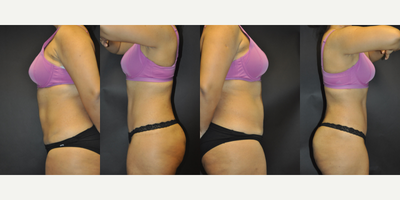
Dear Compassionate, You present a wide range of issues and proposed procedures, so what are the options? For excess fat and skin, liposuction of the abdomen, waist and flanks may bring out more of a waist shape, but will not give the wider hips of an hourglass shape. Here fat grafting could help with augmentation of the lateral buttock or hip dips or the buttock as well. If there is not enough fat or you prefer an alternative, there is structured fat grafting with alloClae. alloCllae can also be a standalone procedure to change the shape of the narrow hips to a wider or rounder shape. No fat harvest is needed with alloClae is it is supplied in ready to graft syringes filled with fat. For a flat tighter, abdomen, a tummy tuck is done to tighten the muscles in the midline. These measures, with suturing of the abdominal fascia in a vertical, lateral position in addition to midline tightening, may give you the narrowing you want without rib modification
Asked By: Sociable792985
ANSWER
Dear Sociable, One of the first things your plastic surgeon has to evaluate is whether there is enough skin laxity in the upper abdomen to allow a full abdominoplasty with removal of the belly button hole that results from a full tummy tuck. Can it be removed with the extra skin? If there is doubt about that, is the position of the belly button high enough and the upper skin laxity small enough to do an umbilical float, a separation of the umbilicus from the abdominal wall? Can the umbilicus slide down when removing the lower skin excess in a mini-tummy tuck, without it ending up too low? If the above options do not appear favorable, and especially if there is abdominal wall laxity or muscle separation that extends to the upper abdomen, will the patient accept a vertical scar below the belly button that results when the umbilical site hole is closed in the full tummy tuck? And if the answer is no, is the patient a candidate for a reverse tummy tuck to take care of the upper skin laxity and excess and deal with the lower skin excess separately. Determining these things obviously requires an in person exam. In your photos the bulge appears only in the lower abdomen, so maybe a mini abdominoplasty with tightening the muscles below the belly button only could work. The appearance of the belly button with excess interior skin can be improved by removing the excess after determining that no hernia is present. These complexities show that a tummy tuck is not a simple operation and that planning and discussion with the patient about surgical possibilities and patient concerns and expectations are very important. You should consult a board-certified plastic surgeon to get the answer to your question.
Asked By: Passionate961193
ANSWER
Dear Passionate, You would start with finding out who you want to do your tummy tuck and see if your gynecologist and your plastic surgeon would like to work together or perhaps they already have. The incidence of abdominoplasty with total abdominal hysterectomy in one study of 10,000 women was one in 50. One in 200 had abdominoplasty and minimally invasive hysterectomy. Complication rates were comparable in all three groups, 9-15%. Operating times were greatest in the abdominoplasty and minimally invasive group. The largest complication rate was superficial surgical site infection, 3.9%. 1.5 days hospital stay for the abdominoplasty with minimally invasive hysterectomy vs 3.1 days for total abdominal hysterectomy. So in the right hands and setting, a minimally invasive hysterectomy can be safely combined with a tummy tuck.
Dr. Robert M. Lowen is highly regarded for his expertise and meticulous approach across various cosmetic procedures. Patients consistently praise his skill in achieving natural-looking results, particularly for lipoma removals, procedures, and tummy tucks. His thorough explanations and attentive care create a comfortable experience, with many noting quick recovery times and minimal scarring. The provider’s ability to address individual concerns and deliver high satisfaction is evident in the positive feedback across all reviewed treatments.