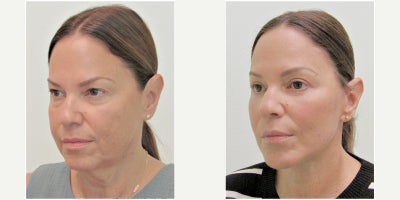
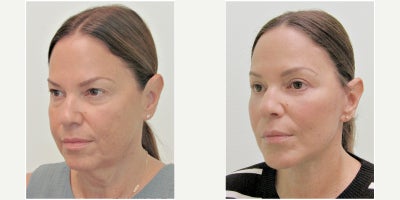
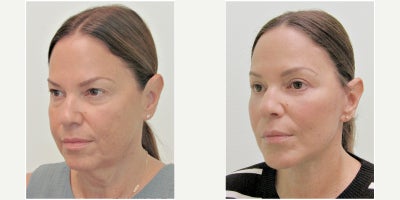
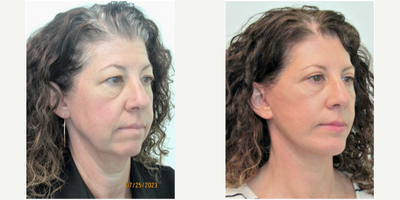
The Lanfranchi Center for Facial Plastic Surgery & Rejuvenation - Las Vegas
8985 S Eastern Ave., Ste. #120, Las Vegas, Nevada, 89123

Show more
Show more
Show more
Since moving from New Jersey to Las Vegas in 2006, I have dedicated my entire career to rejuvenating procedures of the face and neck. Unlike most plastic surgeons who perform procedures on all areas of the body, my exclusive focus and specialty has always be
Asked By: Janet4ta
ANSWER
I am so sorry to hear that you had to endure so many years of orthodontics in order to get your bite and teeth corrected. Normally this is the case where an individual is born with a small jawbone (mandible) and overprotruding maxilla (upper teeth). Simply put, from a lower face and neck aging standpoint, the less structure one has, the less support they have to hold up eventual drooping tissue. Thus patients with small chins tend to age faster, and worse, than their big-chinned counterparts.It seems like you have already learned the hard lesson that other "non-surgical" treatments for a drooping jawline and neck never work. There is no substitute to a well-performed and technically sound lower facelift and necklift. Certainly in your case it is worth considering adding a chin implant to help accentuate your profile and balance your lips and nose. Be certain to seek a surgeon with years of experience and who has a passion for facelifts!
Asked By: day_dreamer92
ANSWER
From a theoretical standpoint, Kybella should offer quickest, safest, and easiest route to eliminating the fat pouch under one's chin. Unfortunately, the test of time has proven otherwise. In our practice we have seen many patients who have failed kybella treatments. Most of these patients report only minimal improvement even after the suggested 2-3 treatment sessions.In my opinion, it is much more reliable, accurate, safer to perform a standard traditional liposuction under the chin. Of course experience and "artistry" of the surgeon is important, but more times than not your result will be better with traditional lipo. Even from a cost standpoint, 2-3 sessions of Kybella costs approximately the same as lipo under the chin (approx. $2,600-$3,200). Be mindful that each Kybella comes with "downtime/swelling" and this has to be performed 2-3 times, whereas lipo is a "one and done" procedure.I personally feel that Kybella is falling out of favor with all practitioners and I expect its use to decline over the next year or two.Hope this helps. - Doc L.
Asked By: ElizabethP8
ANSWER
Certainly losing almost 10% of your weight can effect the overall volume of your face. Unfortunately as we get older we lose the quality of our skin and it is more likely to droop with weight loss (versus if it happened 25 years earlier). Thus, some individuals choose to carry a few extra pounds simply because it fills out the face and makes it appear healthier. Once we get into our 40's and beyond, this weight loss and resultant facial drooping starts the process of considering a facelift for many. If you decide to stay at your current weight, it would be reasonable to consider a lower facelift (even if just a "mini/jawline"lift). Volume replacement in the cheeks/midface could be addressed with either filler or perhaps your own fat via a fat transfer procedure. Fat transfer, of course, would be contingent on you having excess fat (to "donate") in an area that is typically harvested (ie lower abdomen or thighs).
Asked By: twerp1
ANSWER
Thanks for sharing your pics with the community. Based on the photos, I would say that you are indeed a good candidate for both procedures. Typically these two procedures are combined as what we know as a "lower facelift and necklift". Can they be separated? Yes. Do I recommend it? Not at all. The platysma muscle of the neck and the SMAS layer of the lower face/jawline is one continuous sheet of muscle. Having performed over 6,000+ lifts in 14 years, I still believe that the best overall result occurs when you can pull both units at the same time on the same day of surgery. There are many minor "tailoring details" that are effected when one splits the procedures into two separate procedures. Patients who have "minimal" jowling or neck laxity can sometimes get by with just an isolated jawline or necklift. Hope this helps!
Asked By: Pioneering878
ANSWER
As a general rule, all legitimate facelifts (deep plane or otherwise) create a fair amount of swelling, and hence discomfort. In my experience, adding a chin implant usually adds about equal amount of discomfort that one feels on the sides of the ears and neck. The total time of discomfort does not change, and in my experience most patient take low dose prescription pain pills for 2-3 days. The amount of discomfort, and time it lasts, does vary on how much swelling one has, along as other factors such as how tight the headwrap is placed (and materials used). I would mention that the surgeon's experience can also play a role in this as to how much unnecessary trauma is caused during the procedure (hence more pain), as well as his/her post-op protocols.
Asked By: tealeaves
ANSWER
"Threadlifting" has experienced a recent resurgence due to it's appeal of being relatively non-invasive with minimal downtime and complications. Results from threadlifting have been mixed at best. Most frequently there are no complications, just not enough overall result as hoped for.Have a lower facelift and necklift after having threads usually is not an issue. Often these threads are encountered during the lift and can be removed or just "snipped" to release any tension they had created. Preoperatively during the facial exam, a surgeon should be able to tell if the existing threads are a potential issue if he/she sees any abnormal pulling or dimpling.In my experience it is perfectly safe to perform a lower facelift and necklift on previous "thread" patients.
Asked By: duveldog
ANSWER
Thank you for sharing your photos and dilemma. To be concise and quick to the point, there is no substitute for a quality lower facelift and necklift when it comes to eliminating jowls and droopy neck skin. Historically the recovery time for a lower facelift and necklift was up to a month, but with some changes in techniques and protocols, this time can sometimes be shaved down to about a week for recovery. In particular, if you can find a surgeon who performs the lift under local anesthesia (with mild oral sedation) that would certainly speed your recovery (and significantly reduce risk). Please keep in mind that "non-invasive" treatments (ie ultherapy/lasers/radiofrequency) do not mean "risk or complication free". We unfortunately have seen too many patients from other practices who tried these theoretically "safer" modalities only to walk away with scarring and permanent facial and neck damage. The bottom line, in my opinion, is that a lower facelift and necklift performed by an experienced facial plastic surgeon will give you the results you desire with minimal downtime and risk.
Asked By: smashingvalentine
ANSWER
Thanks for providing a great, and quite common, question! Quite simply, nobody's face is exactly symmetric. In over 12 years of practice I have yet to meet a patient where the right side of the face was a mirror image of the left. God made us all imperfect in that regard, so we should embrace it, but also understand it.Evaluating a patient's asymmetry is where the "art" of facial plastic surgery comes into play. My personal philosophy is to first and foremost explain thoroughly to the patient why they are uneven. It's also important to note that usually there are multiple reasons for asymmetry (bony development, uneven sun damage, dominant/non-dominant eye, etc.) and it is typically not possible to make anyone perfectly even. That said, there are a few subtle techniques that can improve unevenness. Most of these come with time and lots of experience. Also having a surgeon with keen eye is equally important.In your case (assuming your photo is not flipped), the right side of your face and neck are more droopy than the left. So it would be reasonable to pull that entire side slightly tighter in an attempt to make it more even. There are a bunch of small important details when a surgeon attempts this, so please be sure your surgeon has plenty of facelift experience.
Asked By: RSProfile6013847
ANSWER
Thanks for offering such an important and common question. In regards to the initial recovery, there is some variation based on the surgeon's preferences. For instance, some surgeons use drains afterwards. Most use a compression dressing afterwards for a day or two or three. Some use a light compression garment for weeks afterwards to support the lift. The bottom line is that no two surgeons have the same post-op protocols. What is most important, in my opinion, is how well and time tested is that surgeon's protocol. For instance, in our Center, we have the same protocol for years (ie no drains) and only slightly tweak it once every few years. Consistency and experience is key.As far as how long it will last, I am attaching a little video to dive into my thought process. As we know there are many factors that determine how long a lift will last. Having performed over 6,000 lifts in over 12 years, I can absolutely say with confidence that the "experience" of the surgeon is what is most important as far as longevity of a lift. All of the subtle details and analysis that go into a lift performed by an highly experienced facelift surgeon matter immensely. Hope this helps, and best of luck to you on your journey! -Doc
Asked By: Ireland007
ANSWER
Thank you for a great question. A neck lift is a surgical procedure and should be performed by a physician who is specialty trained in the anatomy of the neck. Both "general" plastic surgeons and "facial" plastic surgeons would qualify. It is highly recommended that they are board certified by the appropriate Board (for example, be sure they are not "OB/GYN Board Certified" claiming to be a cosmetic specialist). Equally important is to seek a surgeon who performs a few of that particular procedure a few times per week. This would usually be the case when the practice is focused on only one or two areas of the body or face.
Mention RealSelf to redeem.
Dr. Lanfranchi offers treatment packages with additional discounts for patients wanting more than just 1 treatment. Please inquire for more details and mention RealSelf.
Dr. Paul Lanfranchi is highly regarded for his expertise in facial rejuvenation procedures, including , , and . Patients commend his professionalism and the natural results of his work. However, some reviews mention dissatisfaction with the width of implants used and the perceived lack of significant results from the . Despite this, many patients express high satisfaction with the care and support provided by Dr. Lanfranchi and his staff.