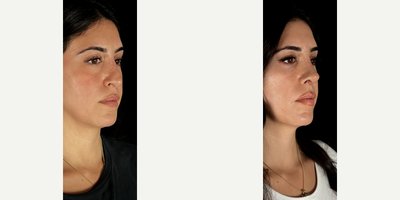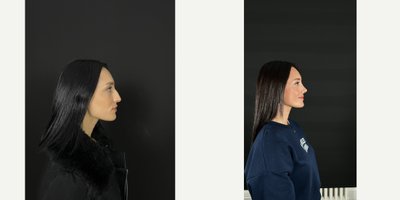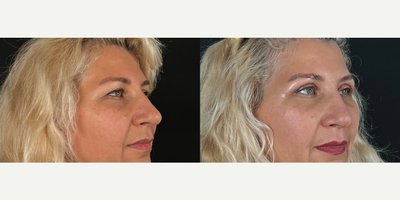
Dr. Delioglu, as an otorhinolaryngology surgeon, has mainly focused on primary and revision rhinoplasty. He aims to gain all his patients not only a natural look but also a better breathing. He also performs other facial aesthetic procedures like otoplasty, bl
Asked By: Kalee421
ANSWER
Thank you for sharing your photos. From this angle, a few things stand out. Lower eyelids: There is mild fullness just below the lash line, a slight hollow where the lower lid meets the cheek, and some loose, crepey skin under both eyes. I do not see large, prominent fat bags in this photo, so the changes are on the moderate side. In a case like this, the lower blepharoplasty would be planned according to what the examination shows. If there is fat bulging under the lids, that fat can be repositioned into the hollow below instead of simply being removed. This smooths the transition between the lid and the cheek and softens the tired look without creating a sunken appearance. A small "skin pinch" can also remove a modest amount of loose skin while keeping the lower lid shape natural and stable. Upper eyelids: Your photo also shows some excess skin on the upper lids, more noticeable toward the outer corners, where it starts to fold down over the lid crease. This hooding can make the eyes look heavier and more tired than you actually feel, and it often contributes to the overall look people notice under the eyes as well. An upper blepharoplasty removes this extra skin, and a small amount of fat if needed, through an incision hidden in the natural crease. The result is a more open, rested eye with a clearer lid platform. Since upper and lower lids age together, many patients your age get the most balanced result when both are addressed in the same session. Before deciding on the upper lids, it is important to check the brow position. If the brows have descended, part of the heaviness may come from there, and that changes how much skin should be removed. It is also worth keeping realistic expectations about the finest surface lines. Blepharoplasty improves contour, fullness and laxity, but very fine wrinkles in the skin itself may soften rather than disappear completely. Photos taken straight on with your eyes open and closed, from the side and while looking up would let us confirm whether you are a good candidate and which approach would suit you best.
Asked By: Peaceful134016
ANSWER
Hello, septoplasty alone would not make any changes to the external appearance of your nose. Asymmetries are among the most challenging aspects to correct in rhinoplasty surgery. However, it should still be possible to achieve a more balanced appearance than what you currently have. It is difficult to make a definitive assessment based on photos alone, but if I had to suggest a technique based on what I can see, I would consider a dorsum preservation / let-down technique.
Asked By: Kind983418
ANSWER
es, when I look at your nose, I can particularly see that it has lost some of its tip support, which has caused the nasal tip to droop. As a result, your nostrils can appear wider, and the tip also drops when you smile. Based on your photos, I can share my thoughts on what could potentially be improved with revision rhinoplasty. First, from the profile view, I can see that the nasal tip appears somewhat too long. Reducing the length of the tip slightly and restoring the nasolabial angle to a more appropriate position could improve the overall balance of your nose. Finally, from the frontal view, there is some deviation of the nasal axis that could also be addressed. However, I cannot promise that the deviation would be completely corrected or that the nose would become perfectly straight. What I can say is that I believe we could achieve a noticeable improvement compared with its current appearance.
Asked By: Plucky949567
ANSWER
Your expectations are realistic and achievable. Looking at your photos, I believe the result you are aiming for is anatomically attainable. The length of the philtrum is not directly changed during rhinoplasty. However, in patients with a drooping nasal tip, lifting the tip can make the philtrum more visible, which may create the impression that it has become longer. In your case, your nasal tip is not significantly droopy, so I would not expect you to experience this issue after surgery.
Asked By: Inventive950961
ANSWER
This is a good question. When calculating the projection of the nasal tip, the rotation of the tip is also taken into consideration, as these two parameters are closely related. The surgeon takes this relationship into account during the planning and calculations of the procedure. Therefore, in your case, deprojection of the tip would not automatically result in derotation. The two parameters are assessed and adjusted together according to your anatomy and the desired surgical outcome.