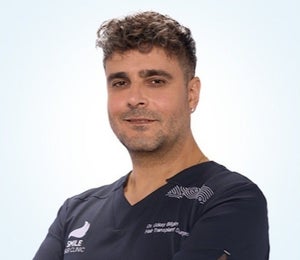
Dr. Gokay Bilgin earned his medical degree from Istanbul University Cerrahpaşa Faculty of Medicine. Throughout his career, he has specialized in medical aesthetics and hair transplantation. As a co-founder of Smile Hair Clinic, currently serving as a Medical D
Asked By: Genius268183
ANSWER
Before considering a hair transplant, trying topical minoxidil would be a reasonable first step, especially if some weakened follicles are still present in those areas. Traction alopecia isn't always permanent, and early or partially damaged follicles may still respond to treatment. Since the patches have been there for over three years, a trichoscopic examination would help determine whether there are still viable follicles or whether scarring has developed. If the hair loss is permanent and the areas have remained stable, a small FUE hair transplant could be a good option to restore the missing hair. It's also important to avoid tight hairstyles or anything that continues to pull on the hairline, as this could affect both existing and transplanted hair.
Asked By: brandonny1
ANSWER
No, starting oral finasteride after a hair transplant will not cause your transplanted grafts to fall out or affect their survival. Some patients experience temporary shedding when starting finasteride, but this is not the same as losing transplanted follicles. The medication actually helps protect your existing native hair from further DHT-related thinning, which is particularly important after multiple hair transplants. Since you're already using topical dutasteride and oral minoxidil, your treatment should be reviewed before adding oral finasteride. Finasteride and dutasteride act on the same hormonal pathway, and combining them isn't routinely necessary. Starting finasteride around the time of surgery is generally possible with your surgeon's approval, but there's no need to take both DHT blockers without a clear medical reason.
Asked By: Versatile39874
ANSWER
Shedding 80–100 hairs daily can still fall within the normal range, but the sudden change following your transplant is worth investigating, particularly since you're noticing it in areas that weren't operated on. Looking at your trichoscopy images, there appears to be some follicular scaling and mild irritation, along with variation in hair shaft thickness. However, these findings alone aren't enough to confirm progressive hair loss or permanent follicular damage. Surgery-related telogen effluvium is a possibility, although persistent shedding over several months may have other contributing factors. Since you've already been taking finasteride for over a year, continuing treatment is reasonable if you're tolerating it well. A dermatologist should compare your current hair density with earlier photographs, assess the scalp for inflammation and consider other causes of diffuse shedding. At six months, recovery is still possible, and the number of hairs shed each day is less important than whether your overall density is actually declining.
Asked By: Clarence3
ANSWER
Two noticeably bald patches in the donor area six months after surgery are concerning, especially following a second transplant. Overharvesting is certainly one possibility. Once follicles have been extracted, they don't grow back in the donor area, so excessive or uneven extraction can leave permanent gaps. However, temporary shock loss, scarring or other scalp conditions can sometimes produce a similar appearance. At six months, most temporary donor shock loss would usually have shown some recovery. The absence of visible regrowth makes a proper donor assessment particularly important. A trichoscopic examination can help determine whether follicles are still present in those patches. If the areas have been overharvested, treatments such as SMP may help camouflage the gaps, but unfortunately, medication cannot restore follicles that have been permanently removed.
Asked By: ozz1
ANSWER
Since your previous beard transplant resulted in persistent ingrown hairs, redness and scarring, the most important step is to identify why this happened before considering another procedure. Incorrect implantation angles or grafts placed too deeply can contribute to ingrown hairs, particularly in the beard area where the hairs need to grow at a very shallow angle. However, ongoing folliculitis or an inflammatory reaction could also explain your symptoms. For a revision, the focus should be on careful graft placement at the correct depth and direction, using appropriately selected grafts rather than simply choosing FUE or DHI. Neither technique automatically prevents this complication. The existing inflammation should be treated first, and repeatedly plucking the hairs may actually worsen the irritation and scarring. A dermatologist should assess the affected follicles before another transplant is planned, especially since you're already dealing with permanent skin changes.
Asked By: annalisewoolley2
ANSWER
Looking at your photo, the asymmetry appears to be mainly related to differences in the shape and arch of your eyebrows, which the previous microblading seems to have accentuated. Botox may help if part of the asymmetry comes from differences in brow position or muscle activity. An eyebrow transplant could also be considered to reshape certain areas and create a more balanced appearance, particularly if the desired shape requires additional hair in specific areas. Since you've already had microblading, correcting or removing some of the existing pigment may also be necessary. The best approach may involve a combination of these treatments, depending on the result you're hoping to achieve.
Asked By: stagnerj
ANSWER
Looking at your photo, the asymmetry is relatively mild, with a slight difference in the arch and position of your eyebrows. Professional eyebrow shaping, threading or subtle makeup adjustments may be enough to create a more balanced appearance. Microblading can also help if you'd prefer a longer-lasting improvement in shape. If the difference is mainly related to brow position rather than hair distribution, carefully placed Botox may help. An eyebrow transplant or surgical correction would generally be unnecessary for such a subtle asymmetry. A conservative approach would give the most natural result.
Asked By: Creative149464
ANSWER
Looking at your photos, there is some mild widening of the central part, but your overall hair density still appears relatively well preserved. Considering the significant emotional stress you have experienced, telogen effluvium is certainly a possible explanation for the shedding. It usually starts a few months after a stressful event and can continue for several months, particularly if the stress is ongoing.The good news is that telogen effluvium usually does not cause permanent damage to the hair follicles, and regrowth is expected once the triggering factors have settled.
Asked By: Courageous347252
ANSWER
Since you have already noticed regrowth with finasteride and minoxidil, that is a positive sign. The shorter hairs may still be miniaturized, and some can gradually become thicker and longer with continued treatment. Dutasteride provides stronger DHT suppression than finasteride and can be considered when the response to finasteride is insufficient. However, combining both medications is not routinely recommended, as there is limited evidence that taking dutasteride once a week alongside daily finasteride provides additional benefit over switching to dutasteride alone.
Asked By: Considerate743726
ANSWER
For beard-to-scalp transplantation, grafts should preferably be harvested only from the safe donor area under the chin. Harvesting from visible facial areas such as the cheeks or mustache is generally not recommended, as FUE extraction in these areas can leave visible scars, hypopigmented dots or permanent textural changes, particularly when the beard is shaved short. If the safe area under the chin does not provide enough grafts, other donor options should be evaluated such as chest,rather than extending the extraction into visible areas of the face.
Dr. Gokay Bilgin and his team at Smile Hair Clinic consistently deliver exceptional, professional care that makes patients feel valued and confident throughout their journey. Patients highlight the clinic's organization, attentive communication, and skilled execution, resulting in natural-looking outcomes that exceed expectations. The entire process, from initial contact to post-operative follow-up, is marked by responsiveness, compassion, and a commitment to patient comfort.