Show more
Show more
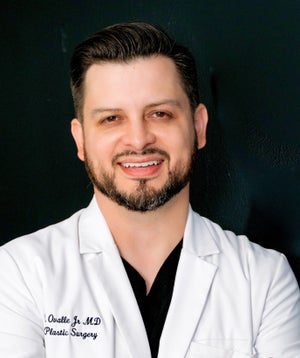
Dr. Fernando Ovalle Jr. is a plastic surgeon in Florida and founder of Black Swan Plastic Surgery. He is double board certified by the American Board of Plastic Surgery and the American Board of Obesity Medicine. He performs a wide range of head-to-toe aesthe
Asked By: Humorous898499
ANSWER
Hello and thank you for your question! As a board-certified plastic surgeon, based on your photos, I do see features suggestive of tuberous or constricted breast anatomy, including a narrow breast base, limited lower pole development, and relatively prominent areolas (indicative of breast tissue 'herniation'). You ask specifically about fat transfer breast augmentation, but a very important consideration is that correcting tuberous breasts involves much more than simply adding volume. The underlying issue is often a constricted breast footprint and tight lower pole, which typically requires surgical release of the constricted tissues, redistribution of breast tissue, expansion of the lower breast, as well as areolar reduction or repositioning to achieve a more rounded, natural shape. While fat transfer can provide beautiful, natural-looking volume, fat transfer alone won't correct these underlying structural/anatomic issues. Implants traditionally are used in tuberous breast correction as they may provide more predictable shape expansion and projection, but they also need to be combined with appropriate tissue reshaping techniques when treating tuberous breasts. If your primary concern is simply having larger breasts and don't mind having the same tuberous shape, fat transfer may be an option, but you would definitely need an in-person exam to assess the amount/adequacy of the donor sites. However, if your goal is to improve both breast size and a rounder less tuberous shape, I would recommend consulting a plastic surgeon experienced in tuberous breast correction rather than focusing exclusively on the choice between fat and implants. Thank you again for your question!
Asked By: ShrinkM8
ANSWER
Hello and thank you for your question! As a board-certified plastic surgeon, I would generally reassure you that most patients with under-the-muscle (dual-plane) implants can return to activities like mountain biking and whitewater rafting without significant long-term limitations. However, there are a few considerations. Because the pectoralis muscle is involved in activities like rowing and paddling, submuscular implants can occasionally cause discomfort, tightness, or visible implant movement with muscle contraction (known as animation deformity). Most patients regain their previous strength and function, although some notice persistent differences. Once fully healed, these activities are unlikely to significantly compromise your results simply because the implants are under the muscle. However, repetitive muscle contraction can occasionally contribute to implant displacement over time. With limited natural breast tissue, dual-plane placement can provide better implant coverage and reduce visible rippling. Over-the-muscle placement isn't necessarily contraindicated with a simultaneous lift, but adequate tissue coverage and thoughtful surgical planning are important. Ultimately, I wouldn't discourage submuscular implants solely because of your hobbies. However, given how physically active you are, I would discuss these specific activities with your surgeon to determine which implant placement best balances aesthetics, long-term stability, and muscle function. Thanks again and good luck with your journey!
Asked By: Selina
ANSWER
Hello and thank you for your question! As a board-certified plastic surgeon, if you're planning to become pregnant within the next year, I would generally recommend waiting until after pregnancy and breastfeeding before undergoing a breast lift. Pregnancy can significantly change breast volume and stretch the skin, potentially compromising your results. However, this doesn't necessarily mean your results would be completely undone. Some women maintain excellent results, while others experience enough recurrent sagging to consider revision surgery. Unfortunately, it's difficult to predict. Adding implants doesn't necessarily prevent these changes, either. That said, I completely understand not wanting to put your confidence on hold for several years. If you're comfortable with the possibility of needing a revision after pregnancy-related changes, proceeding now isn't a "wrong" answer. Ultimately, it's a personal decision that balances your current happiness with the long-term durability of your results. Thanks again and good luck with your journey!
Asked By: petal25
ANSWER
Yes — absolutely. If you carry enough excess fat in the lower abdomen and flanks, those areas can often provide sufficient donor fat for a smaller, more subtle BBL focused mainly on filling the hip dips and improving the overall roundness of the hips. For a natural result, the goal would usually be less about dramatically increasing projection and more about improving the transition from the waist into the hips. The amount of enhancement possible depends on how much usable fat is available after liposuction and how much survives after transfer. The incisions used for liposuction and fat transfer are very small, typically only a few millimeters. We usually try to place them in discreet areas such as the lower abdominal crease, around or within the belly button when appropriate, and in concealed areas near the flanks or bikini line. The exact number and location depend on which areas need to be treated and the safest access for even contouring. With four pregnancies, I would also want to assess the quality of the abdominal skin and whether there is any muscle separation or laxity, since liposuction removes fat but does not tighten significantly loose skin. In the right candidate, though, lower abdomen and flank liposuction combined with conservative hip-dip fat transfer can create a very subtle, feminine, natural-looking improvement.
Asked By: nessa21
ANSWER
Hello and thank you for your question! Congratulations on your weight loss! That is truly life changing. Of course with that much weight loss, there is extra skin/loose tissues that come as as result. You are correct in that a tummy tuck would be the most powerful way to dramatically change your waist/abdomen shape and contour, as long as you are at/as close as possible to your goal weight. If you are also committed to improving the shape, volume and contour of your gluteal region, a BBL surgery is absolutely the best way to accomplish that. This requires liposuction, typically 360 degrees around the trunk to have enough good quality fat to do a nice fat transfer. If you are doing both surgeries together, I think it is smart to stage them out, at least 3-6 months between surgeries for recovery/healing purposes. To me, it makes the most sense to do the liposuction and fat transfer (BBL) first. If you did a tummy tuck first, that typically involves liposuction of the flanks as well to improve the result - you would be removing a lot of good quality fat cells on the front and sides of the trunk and "throwing them away", so they would not be available for the BBL afterwards. It is true that you would be left with "loose, extra skin" after liposuction of your abdomen, but that would be addressed at the secondary tummy tuck surgery. The next best step is to seek an in person consultation with board certified plastic surgeon to further discuss your goals and concerns. Good luck on your journey!
Asked By: draggo09
ANSWER
Hello and thank you for your question. Based on your photos, you could have a great result to improve the appearance of the gluteal region with liposuction and fat transfer (BBL). Liposuction alone of the lower back/love hand region will "subtract" and create improved waistline and definition of the upper gluteal region, while transfering that fat to the gluteal region will further add volume, projection and contour to the hip dip regions. Liposuction on your abdomen would help to flatten and improve shape and contour but it would be important to distinguish what part of your anatomy may be due to visceral (intraabdominal) content/diastasis (muscle separation). You may need a tummy tuck to achieve a truly flat/tight abdomen if that is also your priority. Your next best step is to see a board certified plastic surgeon for an in person consultation to discuss your goals and examine your specific anatomy. Good luck on your journey!
Asked By: saharms
ANSWER
Hello and thank you for your question! If you are staging the procedures, I would generally recommend allowing several months between a BBL and a tummy tuck so the swelling has resolved, the fat transfer has stabilized, and your tissues have had time to recover. In many patients, around 3–6 months is a reasonable window, although the exact timing depends on how extensive the first surgery is and how you heal. For the tummy tuck, whether to use traditional liposuction, VASER, or J-Plasma/Renuvion depends on your anatomy, skin quality, prior liposuction, and the amount of contouring needed. VASER can be useful for more detailed fat removal, definition and "breaking up" of previous scar tissue, but it is not automatically better for everyone. J-Plasma/Renuvion and other RF skin tightening technologies can provide additional skin contraction in selected areas, but it does not replace removal of truly excess skin with a tummy tuck. Yes, abdominal etching can be performed with or without VASER-assisted or RF-assisted liposuction, but the result depends much more on careful surgical planning, your underlying muscle anatomy, skin thickness, and how much superficial fat is present than on the energy device itself. Since you have had prior abdominal liposuction, I would be especially cautious about aggressive repeat liposuction because scar tissue and altered blood supply can increase the risk of contour irregularities and healing problems. The best plan would be based on an in-person exam and review of exactly where the first liposuction was performed. Good luck on your journey!
Asked By: coxysue
ANSWER
Hello and thank you for your question! A tummy tuck with liposuction can be a very effective option for someone like you if the main goals are to tighten the abdomen and create more waist definition. You do not need to have had children or massive weight loss to be a candidate. Some patients simply develop skin laxity, lower abdominal fullness, or changes in the abdominal wall over time with aging, weight or hormones changes, etc. Whether you have “enough” fat for liposuction depends more on where the fat is distributed than on your overall size. Even relatively lean patients can benefit from targeted liposuction as an adjunt to improve contour instead of leaving all of the shaping/contouring up to the "removal and pulling" of the skin from the tummy tuck. Swelling and some temporary firmness are expected after surgery, and areas treated with liposuction can feel firm or irregular during the healing process. True problematic fibrosis is less common and can usually be minimized with good surgical technique, appropriate compression, early mobility, and postoperative care. Thanks again and good luck on your journey!
Asked By: mainemom
ANSWER
Hello and thank you for your question! Yes, per your photos, this appears to be a “waterfall deformity,” where the natural breast tissue gradually descends over the implant while the implant itself stays higher on the chest. The dent or contour change along the lower part of the breast could also be related to thinning tissue, implant position, scar tissue, or changes in the breast envelope over time. In many cases this is primarily cosmetic, but since the appearance has progressively changed, I would recommend having it evaluated. There isn’t a set time when implants automatically need to be replaced. Revision is generally considered when there is a noticeable change in shape, implant position, firmness, discomfort, rupture, or simply when the appearance no longer matches your goals. At 11 years, it is very reasonable to have the implants and surrounding tissues assessed. If you are considering revision (which would likely entail an implant exchange and a breast lift), going somewhat smaller can often be helpful, particularly when combined with reshaping or another lift if needed. The best approach would depend on your current implant position, skin quality, breast tissue, and whether there is any capsular contracture or implant issue. I would recommend an in-person evaluation with a board certified plastic surgeon as the next best step. Good luck on your journey!
Asked By: Reserved147312
ANSWER
Hello and thank you for your question. This is a very reasonable concern. Renuvion can improve skin contraction after liposuction, but there is essentially no good clinical data specifically evaluating Renuvion in patients with hypermobile Ehlers-Danlos syndrome (hEDS). Therefore, I don't think anyone can confidently tell you that it is equally effective in that population. Renuvion works by delivering helium plasma/radiofrequency energy to the tissue beneath the skin, producing immediate tissue contraction as well as a longer-term healing/remodeling response. Studies in the general population show meaningful tissue contraction and high overall satisfaction, but these studies have not specifically evaluated patients with EDS. With EDS, my bigger concern would be predictability rather than simply whether the device "works." There are different subtypes of EDS which all involve abnormalities of connective tissue, and varying degrees of skin laxity, bruising, tissue fragility and impaired wound healing can occur depending on the subtype. That means your skin may not retract after liposuction—or remodel after an energy-based treatment—as predictably as someone with normal connective tissue. Renuvion also cannot compensate for significant excess skin in the way a tummy tuck can. Based on what you describe, I actually think your surgeon's approach is very reasonable: perform conservative, well-planned liposuction, allow the tissues to completely settle, and then reassess whether the remaining laxity bothers you enough to justify another procedure. I would personally be cautious about adding Renuvion simply because you're hoping to guarantee avoidance of a tummy tuck—it may improve contraction, but it cannot guarantee that outcome, particularly when an underlying connective-tissue disorder is suspected.
Dr. Fernando Ovalle Jr. is consistently praised for his attentive listening, thorough explanations, and compassionate care. Patients highlight his patience, skill, and ability to make them feel comfortable and confident throughout their procedures. The staff is described as friendly, professional, and supportive, contributing to a positive overall experience. Results are frequently noted as exceeding expectations, with many patients expressing strong intent to return for future procedures.