
Callum Faris is a Specialist in Facial Plastic Surgery and Otolaryngology working in a team in the Face Institute. He is an expert in facelift surgery, facial paralysis surgery, rhinoplasty, revision rhinoplasty and nose reconstruction.
Asked By: mel1745
ANSWER
If the rib graft supports the tip its removal will result in a deprojected tip which will be more round and less defined. The question is why is it necessary to remove the rib graft?Is it infected?Fat grafting will give projection but the tip will not be defined - it will remain bulbous and blunted. Cartilage from the ear is an alternative but a careful clinical assessment needs to be made first.
Asked By: Creative160723
ANSWER
I assume you mean hairline lower surgery. If they are to be done separately, I would recommend hairline lowering first then revision rhinoplasty second. It is not an issue with apparent projection but more excess skin at the glabella or radix. It depends on your specific skin excess and thickness situation if there could be an issue or not.
Asked By: elleirum
ANSWER
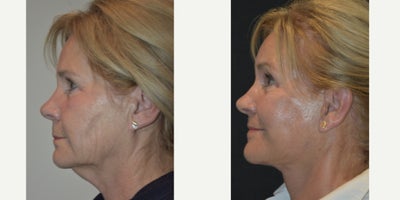
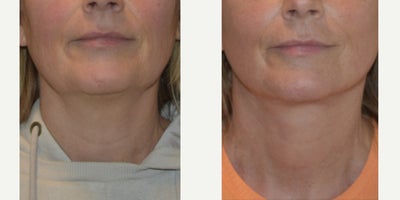
You are beginning to develop platysmal bands. Many people with heavier necks these early bands are concealed under a fat layer only becoming more promient when they are larger. Botox is a nonsurgical option. Surgical option would be include a submental neck lift with platysmaplasty. The platysmal muscle is repaired with sutures. A midface lift would not address this area.
Asked By: misshmx
ANSWER
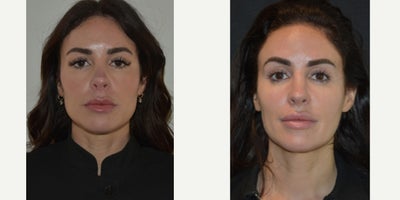
Upper lip elongation can occur with age or following a rhinoplasty. In your case it is not clearly elongated to my eye. To be more precise, one would have to see older photos of yourself and measure your upper lip in clinic. Looking at your lip architecture, you already have a prominent central portion to the cupids bow. Therefore, if any bullhorn lip lift was to be performed, consideration to combining it with corner lip lift would seem sensible.
Asked By: Intelligent925476
ANSWER
Thanks for the question. It looks like the left nasal bone is collapsed in. Palpation of the nasal pyramid/bones in clinic would clarify the diagnosis.Bony abnormalities do not tend to improve with time. Irregularities tend to persist or become more apparent as the oedema of the skin subsides. Nasal bone collapse can occur when a nasal bone is overly mobile following an uncontrolled fracture. This occurs not infrequently with the use of osteotomes to break the nasal bones.These issues can be improved with a revision rhinoplasty. Using a piezo ultrasonic machine to precisely rebreak the bone and reposition the nasal bone would be an ideal tool to perform this surgery.
Asked By: Cute387767
ANSWER
Correction of deviated nose is a common cause for patients seeking revision rhinoplasty. The down time is similar to primary rhinoplasty of around 2 weeks. Cost vary but most revision rhinoplasty specialists start at around 8000 euro and increase depending on complexity and duration of the operation. Some revision rhinoplasties with rib grafting can take 6 hours. It depends on the current situation and what exactly you wish to have revised/corrected.
Asked By: elleirum
ANSWER
Fat grafting in isolation can be used to treated mild to moderate volume loss associated with ageing. In your case the perioral area piriform aperture and can be grafted which can soften the nasolabial folds. Additionally fat grafting to the tear trough area and lateral orbital area are also commonly helpful in your age range. This can give you a more refreshed look. You should avoid excess fat grafting to the midface as this if done incorrectly can actually increase the nasolabial folds. Seeing photos of your facial volume when you were younger/the look you wish to regain would be helpful to personalise your plan. I hope this helps, and thank you for your question.
Asked By: Ash108580
ANSWER
Thank you for your questions.This is a frequent unwanted effect of primary rhinoplasty that I see commonly. Given the degree of rotation of the columella segment compared to the alar segments I think a there is a significant chance the shortening of the nose at least in part was due to shortening of the septum. There are two options I commonly use: 1. Build on the current framework with de-rotating grafts in infratip lobule which will produce a modest derotation effect at best. The second is extending the septum with an septal extension graft. This latter choice would be the most classical and robust way of lengthening and derotating the nose. If there is still excess inner lining and the soft tissue is pliable and flaccid then there is a chance wide underming including the lining and derotation in combination with a largish columella strut may hold the tip in a more derotated position ........ but this is a gamble and over correction of the derotation would be needed as some degree of relapse is always inevitable when the tip is not fixed. If the skin envelope is tight, and also very importantly the inner lining is retracted then there is no other reliable option than creating a firm nasal tip. Without firm fixation of the tip in a derotated position the tip will in my experience slowly over time rotate upwards (even 5 years after) unless fixed securely in the lower position.
Asked By: mel1745
ANSWER
Technically, most changes are possible through a closed approach. However in a rib graft revision rhinoplasty, in my hands I would almost always perform an open approach to get the best access to have best ability to shape and narrow the tip. With all things in rhinoplasty it is the result not the approach that matters. I dont think an in office surgery would be the ideal approach.
Asked By: magic5689
ANSWER
There are lower chances of perforation repair with unilateral repair mucosal without a graft in our experience. Highest chances or repair are with bilateral mucosal repair with cartilage. I prefer bilateral repair with temporalis fascia and cartilage for the highest chance. Best chance of repair is with the first repair/attempt.
Dr. Callum Faris is praised for delivering natural-looking results that significantly improve patients’ quality of life, particularly for functional concerns like breathing and sleep. Patients appreciate his attentive listening and comprehensive approach to both cosmetic and medical needs. The surgical process is described as smooth, with positive experiences across pre-op, surgery, and recovery phases. His team, including nurses and anesthesia staff, consistently receives commendations for their support and reassurance.