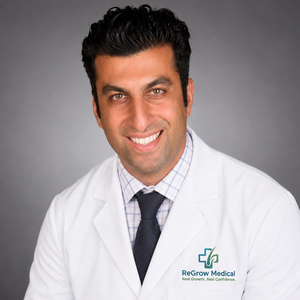
ReGrow Medical is dedicated to one area of care: hair restoration. Founded and led by Dr. Amiel Moshfegh, the Southern California practice focuses on FUE hair transplantation, eyebrow restoration and beard restoration, with an approach built around individual



Asked By: Optimistic779016
ANSWER
At six months, the earlier grafts may still be maturing, so it can be premature to judge how much additional density is needed. A small graft count alone does not establish that another procedure is appropriate. Your surgeon should assess healing, existing growth, and donor supply before deciding whether to wait or proceed in the same area.
Asked By: lazlo3184
ANSWER
Temporary shedding of nearby hair can occur after another transplant, but thinning at six months should not automatically be attributed to shock loss. Density may continue improving through 12–18 months, particularly in the crown. Ask your surgeon to compare your current growth with your preoperative baseline and assess ongoing hair loss; improvement by one year cannot be guaranteed.
Asked By: Diligent95631
ANSWER
Some thickening can continue beyond nine months, but no visible new growth at this stage warrants an in-person assessment rather than reassurance alone. Arrange follow-up with your transplant surgeon to examine the scalp and review your progress and procedure records. Your description alone cannot establish graft failure or whether another procedure is appropriate.
Asked By: Pioneering491449
ANSWER
At six months, transplanted hair may still look fine and sparse; thickness and coverage can continue improving over 12–18 months. This does not establish whether your individual growth is on track. A follow-up examination with your surgeon can assess progress and clarify realistic expectations before considering further treatment.
Asked By: Florador
ANSWER
Male pattern baldness does not automatically make a transplant unsuccessful. Follicles selected from a stable donor area are generally more resistant to DHT and can retain that resistance after transplantation. However, surrounding native hair may continue thinning, and lifelong survival of every graft cannot be guaranteed. Your nephew should see a dermatologist or hair-restoration physician to confirm the diagnosis, assess his donor area, and discuss treatment to preserve existing hair before deciding on surgery.
Asked By: Anthony R
ANSWER
Great question. A three-hair graft usually represents one follicular unit containing three individual hair follicles. Although those follicles were extracted and implanted together, the three hairs do not necessarily become visible at exactly the same time. One or two hairs may emerge first, while another remains in the resting phase longer or initially grows as a finer, lighter hair.At seven months, the transplant is still developing. It is common to see differences in the timing, length, thickness, and appearance of the transplanted hairs. Published clinical observations show that visible growth may begin over a range of several months and that density can continue improving well beyond the six-month point.Therefore, seeing fewer than three visible hairs in the area of a three-hair graft does not automatically mean that one of the follicles failed. It is also difficult to evaluate an individual graft with the naked eye because neighboring hairs can overlap. The best way to assess progress is through standardized photographs and an examination by your treating physician, preferably with magnification.If your overall growth has been very limited at seven months, or you are experiencing redness, pain, scaling, drainage, or increasing patchiness, I recommend scheduling a follow-up examination. However, uneven growth by itself can still fall within the normal maturation process.
Asked By: Exquisite421995
ANSWER
No, transplanted hairs do not need to begin growing immediately after a hair transplant. During the first few weeks, some hair shafts may appear to grow slightly, while others remain unchanged or shed without any noticeable growth. That variation alone does not indicate whether a graft survived.Between approximately two and six weeks after the procedure, many of the visible transplanted hair shafts shed as the follicles enter a temporary resting phase. The important distinction is that the hair shaft may fall out while the living follicle generally remains beneath the scalp. New growth commonly begins around three to four months, becomes increasingly noticeable between four and six months, and continues to thicken and mature for up to 12–18 months.Therefore, if some transplanted hairs did not appear to grow and then disappeared during the shedding phase, it does not automatically mean those grafts were lost. Graft survival cannot be accurately judged from early shedding alone. Progress is better evaluated through follow-up examinations and standardized photographs over several months.Contact your treating physician sooner if you develop increasing redness, pain, swelling, drainage, fever, persistent bleeding, or other unusual symptoms. A follow-up evaluation is also appropriate if there is no meaningful evidence of new growth by approximately six months.
Asked By: TZ2
ANSWER
For many appropriately selected patients, a 2,000-graft FUE can be completed in one well-planned session. There is no general rule that dividing the procedure into two separate 1,000-graft sessions will automatically improve graft survival.Graft survival depends more on surgical technique and workflow than on the number 2,000 itself. Important factors include minimizing follicle transection and dehydration, proper graft storage, limiting out-of-body time, gentle handling and implantation, and avoiding excessive trauma or overly dense placement in the recipient area. The patient’s health and comfort, anesthesia exposure, procedure duration, and surgical-team fatigue should also be considered.I would consider staging the procedure when the donor supply is limited, the recipient scalp has scarring or reduced blood supply, the planned density would be too aggressive for one session, or medical factors make a shorter procedure preferable. Otherwise, completing 2,000 grafts in one session is often more practical and avoids a second operation and recovery period.The final recommendation should be based on an examination of the donor density, hair caliber, degree of miniaturization, recipient-area size and condition, medical history, and expected long-term pattern of hair loss. This is general information and not a substitute for an individualized medical evaluation.