Acne Scars
Dealing with active breakouts is stressful, but tackling the scars they often leave behind can sometimes be worse. Recognize what acne scars are and explore all the options for fading them for good.
Dealing with active breakouts is stressful, but tackling the scars they often leave behind can sometimes be worse. Recognize what acne scars are and explore all the options for fading them for good.
What causes it
Top treatments
Other options to consider
Skin-care solutions
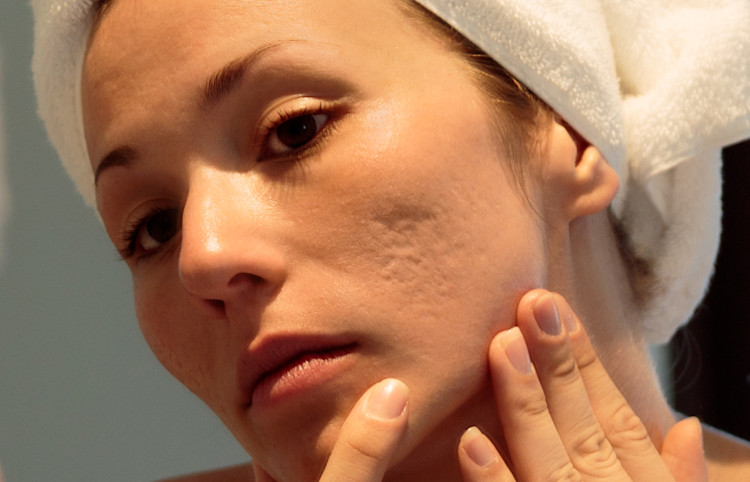
Infected and inflamed acne lesions can damage the afflicted pores and surrounding tissue, leaving behind scars long after the skin has healed.
There are two categories of acne scars: atrophic and hypertrophic. Indented, atrophic scars result from tissue loss, while raised, hypertrophic scars are caused by excess tissue.
Within those two categories, there are four types of acne scars.
- Ice pick scars are narrow, deep holes that look like large pores. They develop after an infection (like a cystic acne pimple) works its way up from below the surface, leaving a column of damaged tissue.
- Rolling scars are sloping depressions created by fibrous bands pulling on the epidermis from deeper down, giving the skin an uneven, wavy look. They’re most common in areas where the skin is thicker, like the lower cheeks and jaw.
- Boxcar scars are round and pitted, with defined edges—similar to chicken pox scars. They’re left behind when inflammation destroys collagen. Without this structural support, the skin sinks in.
- Keloid scars are hypertrophic raised scars created by an overproduction of collagen during the wound-healing process. They look like raised bumps and can extend beyond the area of the original wound. As the acne wounds heal, this overproduction of collagen results in a mass of raised scar tissue on the skin’s surface, leading to uneven texture.
Injury and inflammation from acne can also cause increased pigment production that results in dark marks of postinflammatory hyperpigmentation (PIH). Most common in people with olive and brown skin, these flat, dark spots of discoloration (red, purple, brown, or black) occur when skin irritation triggers excess melanin production. Oftentimes, PIH can be managed with over-the-counter skin-care products containing ingredients like vitamin C, glycolic acid, lactic acid, and retinol as well as with diligent use of sunscreen with an SPF of at least 30.
Most of the time, acne heals and fades, leaving unblemished skin in its place—but that’s not always the case. Breakouts, no matter how mild or severe, can cause scars to develop in their place.
The best treatment for acne scars will depend on the type of scars you have and your skin type. A dermatologist can examine your skin and recommend the best treatments for you.
“The majority of patients will have a variety of different scar types,” says Dr. Davin Lim, a dermatologist in Brisbane, Australia. “Careful examination—especially under angled lighting, with scar mapping—will give an understanding of the best options for you.”
It’s also best to have acne breakouts under control before beginning to address any scars. If you also have active acne blemishes, your dermatologist can help you with skin care for acne treatment first—in ways that can mitigate further acne scarring.
According to doctors and RealSelf members, the following treatments are best for diminishing acne scars.
- Chemical peels improve the appearance of scars by removing dead skin cells and allowing new, healthy skin to grow in its place. A medium or deep peel is best for acne scarring and texture irregularities, since each penetrates the superficial epidermis and into layers of the lower dermis. Your provider may recommend a TCA peel, Jessner peel, or phenol peel. The deeper the peel, the longer the downtime. Your skin will be inflamed and flaky for up to two weeks, after which brighter and smoother skin will be revealed. Results will continue to improve for three months. You will most likely need a series of peels or a combination approach, for best results. Find doctors who offer chemical peels
- Laser resurfacing improves skin tone and texture by causing microdamage and triggering the body’s regenerative healing response. Ablative lasers remove the surface layer of the skin, while non-ablative lasers leave it intact and target the lower layer. An ablative laser treatment will yield more significant results, but it will also involve serious downtime. Doctors on RealSelf recommend CO2 laser or YAG laser treatment, but they say several sessions may be needed and that laser resurfacing works best as part of a combination treatment. “It is difficult to get great results with just one treatment—multiple treatments and a combination of modalities typically have the best end result,” says Dr. Meghan Nadeau, a plastic surgeon in Seattle. “In our practice, we like to use a fractionated erbium laser, microneedling with PRP, and TCA peels. Acne scars can be difficult to treat, and results can vary, depending on the severity.” Find doctors who offer laser resurfacing
- Subcision is commonly used to improve rolling scars. It breaks up below-the-surface fibrous tissue bands with a needle or blunt-tipped cannula, allowing the area to lift. The majority of specialists will use cannula subcision, since this has been proven to be more effective and have fewer side effects compared to needles. Subcision can be considered keyhole (minimally invasive) skin surgery and involves the insertion of a cannula beneath the surface of the skin. The instrument is then moved back and forth, to break the bands. It’s performed under local anesthesia and takes 30–60 minutes per session. It’s recommended to treat one to two areas at a time in order to minimize side effects like swelling, bruising, and tenderness. “While subcision will give you immediate benefits, the best results are when we perform the procedure every six to nine months, over a period of years,” says Dr. Harold J. Kaplan, a facial plastic surgeon in Torrance, California. “This increases your chances of having collagen remodeling fill in the scar from below.” Your doctor may also recommend combining subcision with another treatment option, such as microneedling or laser resurfacing, for best results. Injectable fillers can also contribute a further lifting effect. Find doctors who offer subcision
- Bellafill, a dermal injectable filler, can camouflage atrophic acne scars by filling in indentations. It’s often combined with subcision, since the vast majority of acne scars are atrophic. Filler corrects depressions in the skin due to lost collagen and fat. Currently, Bellafill is the only FDA-approved acne scar filler. It’s made of a resin called polymethyl methacrylate (PMMA) and bovine collagen. Beyond the immediate volume gain, the collagen in Bellafill helps boost the body’s own collagen production “It works best for scars that are soft and rolling,” says Dr. Brian Windle, a plastic surgeon in Bellevue, Washington. “Heavy, thick scars and ice pick scars are often better treated with either excision or steroids before using Bellafill.” Bellafill lasts up to five years—longer than any other filler on the market—but the results are still temporary. Depressed acne scars are simply disguised for as long as the filler remains. Find doctors who offer Bellafill
- Microneedling uses tiny needles to puncture the top layer of skin, triggering the body’s natural wound-healing response and the production of new collagen and elastin. It’s also known as collagen induction therapy. The treatment can be performed with a derma roller or an automated device like the Dermapen, which contains sterile, single-use needle cartridges. The needles range in depth from 0.5 mm to 2.5 mm, and your provider can customize the treatment to best address your acne scars. Depending on scar depth and size, you may need numerous treatments, spaced four to six weeks apart. A microneedling treatment can also be followed by the topical application of growth-factor-rich platelet-rich plasma (PRP) derived from your own blood, to further boost results. This combination treatment is known as a Vampire Facial. Find doctors who offer microneedling
Related: Botox May Now Improve Facial Scars
- Punch excision uses a sharp, cookie-cutter-like instrument to punch around a scar and remove it; the hole is then closed using very fine sutures. It works best for ice pick scars or boxcar scars no larger than three millimeters. The procedure does leave a thin linear scar, but it should be much smaller and lighter than the original. Alternatively, punch elevation is a procedure that involves surgically lifting the scar, to match the contours of surrounding skin. This procedure is best for scars between three and seven millimeters wide. “I have found that it takes at least six months to see the final result from an excision,” says Indianapolis facial plastic surgeon Dr. Greg Chernoff. “Wearing some scar tape or scar gel can aid in the healing process.”
While acne scarring can be difficult to treat with over-the-counter skin-care products, they can certainly help—especially when used consistently.
Retinoids are a top product choice when treating acne scars. A study found that retinoids can reduce hyperpigmentation in scars and make them less noticeable, in addition to improving cell turnover and reducing acne lesions. Try the Obagi360 Retinol 1.0 to kick-start scar reduction at home.
Salicylic acid, an ingredient traditionally used to treat active breakouts, is also great for diminishing acne scars. This pore-clearing ingredient is considered one of the best treatments for acne scars, thanks to its ability to improve cell turnover.
Finally, those with acne scars should incorporate another exfoliant: alpha hydroxy acids. These acids buff away debris and dead skin cells from the skin, revealing fresh, new skin underneath.
Updated July 6, 2021